

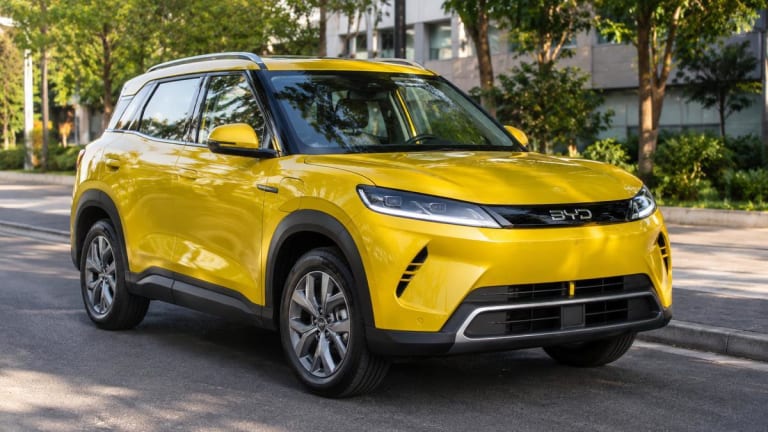
BYD unveiled the 2027 line of the compact SUV Yuan UP in China, known in Brazil as the Yuan Pro, highlighting an impressive range of up to 501 kilometers and aggressive pricing.
The automotive giant BYD surprised the international market by revealing significant updates to its line of compact electric vehicles. The model, also sold as Atto 2 in other global markets, underwent a strategic overhaul focused on energy efficiency and commercial competitiveness. The main technological innovation lies in the introduction of larger battery packs, allowing the SUV to achieve remarkable range on a full charge, solidifying the brand’s push into affordable electrified mobility.
The arrival of the Yuan UP Feichi Edition marks a shift in the Asian manufacturer’s engineering approach. Available in five distinct configurations in the local market, the vehicle offers a range of battery options to meet different consumer profiles. With prices starting at highly competitive levels domestically, the automaker demonstrates that its core goal is to mass‑enable sustainable mobility, challenging traditional competitors and redefining sector standards.
Technical evolution and extended range
The major technological leap for the SUV lies in adopting the new generation of lithium iron phosphate batteries, globally recognized for excellent thermal stability and high operational durability. Consumers now have three capacity options: 32 kWh, 45.12 kWh, and the brand‑new top‑tier 51.13 kWh.
This larger energy option delivers the 501‑kilometer maximum range in the higher configurations. However, it is important to note that this figure was achieved under the rigorous Chinese CLTC homologation cycle, whose parameters often yield more optimistic results than the standard adopted by Inmetro in Brazil.
Efficiency Over Pure Power
To achieve high levels of energy efficiency, the manufacturer chose to readjust the vehicle’s mechanical assembly. While previous editions featured more powerful propulsion systems, the 2027 line is now uniformly equipped with a 70 kW front electric motor, equivalent to about 95 horsepower and 180 Nm of torque.
This strategic decision clearly prioritizes urban use and maximizes range, although it may require drivers who prefer more immediate responses in overtaking to adapt.
The brand’s priority now is to deliver maximum efficiency, extended range, and highly competitive prices for the urban consumer.
the automotive sector analysis points out the company’s new engine strategy.
In addition to the powertrain, the interior has been completely redesigned to incorporate premium technology. The cabin now features a 12.8‑inch rotating multimedia center, an 8.8‑inch digital dashboard, and the advanced DiLink connectivity system. Features such as up to 50 W inductive charging, ventilated seats, and a panoramic roof complete the comfort package.
The impact of this renewal moves the global electrified vehicle market and generates high expectations for the automaker’s next steps in Latin America. Although the Brazilian subsidiary has not yet confirmed the exact import of this 501‑km configuration for the national Yuan Pro, the arrival of more refined technologies and higher‑capacity batteries in the brand’s catalog indicates that competition in the compact electric SUV segment will remain heated in the coming months, demanding swift responses from other industry competitors.