Vallourec has taken a decisive step toward sustainability by implementing a Central Burner at its forestry unit in Minas Gerais, reducing methane and carbon monoxide emissions in charcoal production by up to 99%.
The search for cleaner industrial processes has reached a new level in the renewable energy and steelmaking sectors.
Vallourec, a global leader in tubular solutions, announced the implementation of an innovative technology at its facility located at Fazenda Aldeia, in Abaeté (MG).
The project focuses on strict control of wood carbonization, transforming the way the company manages its gaseous waste.
The initiative not only reinforces the company’s commitment to the environment,
but also demonstrates how engineering can be applied to mitigate local impacts.
By virtually eliminating the smoke and odor characteristic of charcoal production,
the facility establishes a new operational standard that directly benefits the neighboring community
and the quality of the working environment.
Technological Innovation in Emissions Control
The operation of the new Central Burner is based on a duct system that collects
the gases generated during wood pyrolysis.
About 300 meters of piping direct these compounds, previously released into the atmosphere,
to a dedicated combustion chamber.
At this stage, the gases are subjected to temperatures exceeding 600 °C,
promoting efficient oxidation.
One of the most relevant points is the system’s self-sufficiency.
The energy required to maintain combustion is provided by the gas generated in the process itself,
eliminating the need for external fuels.
As a result, the company recorded a 99.98% reduction in carbon monoxide (CO) concentrations
and a 99.3% reduction in methane (CH₄).
Jun Mutó, Director of Raw Materials at Vallourec South America, stated:
The Central Burner represents an important advancement for our operations and reinforces Vallourec’s commitment to innovation, continuous improvement, and sustainability. We are very proud of the completion of this project, which addresses an operational challenge with concrete, measurable environmental results, demonstrating how technology can contribute to an increasingly efficient and sustainable operation.
Engineering and Community Dialogue
The implementation of this technology was the result of a collaborative effort
involving Vallourec, the São Sebastião da Aldeia Community Residents Association,
and the Public Prosecutor’s Office.
This dialogue was key to ensuring that the solution met both operational needs
and the expectations of local residents, fostering harmonious coexistence.
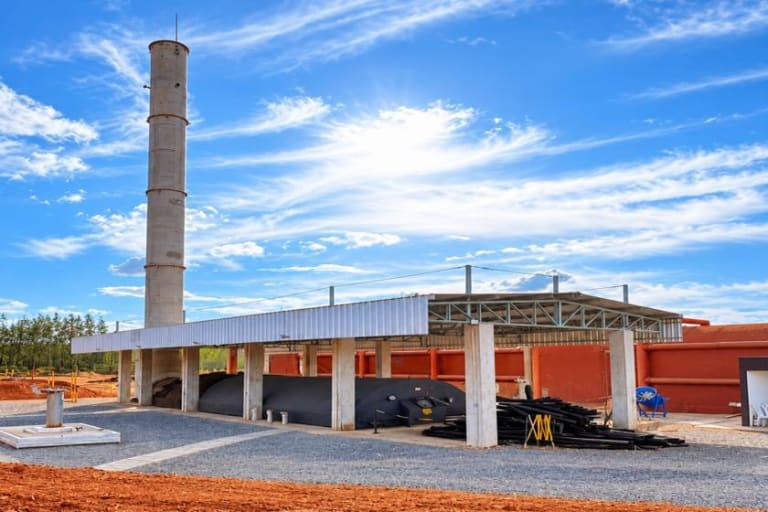
The structure consists of a 30-meter-tall metallic chimney
and a robust thermal insulation system.
The visual and environmental result was immediate: what was once dense smoke
is now replaced, at the burner outlet, essentially by hot air.
Marcelo Fontan, Project Manager at Vallourec South America, commented:
In addition to the significant reduction in these gases, the changes are noticeable in daily operations. The gas previously generated in the carbonization process is no longer emitted from the kiln chimneys, and the odors associated with the activity have been eliminated. At the burner outlet, what is observed is essentially the emission of hot air.
Impacts and the Future of Clean Energy
This project is a practical example of how ESG strategies
(Environmental, Social, and Governance) can be integrated into daily industrial operations.
The drastic reduction in greenhouse gas emissions, such as methane,
places the company’s charcoal production on a higher level of climate responsibility.
Looking to the future, Vallourec plans to continue investing in technological solutions
that minimize the carbon footprint of its operations.
The scalability of this technology to other units could be a natural step,
reaffirming the company’s leadership in the energy sector
and in the pursuit of industrial processes increasingly aligned with environmental preservation.