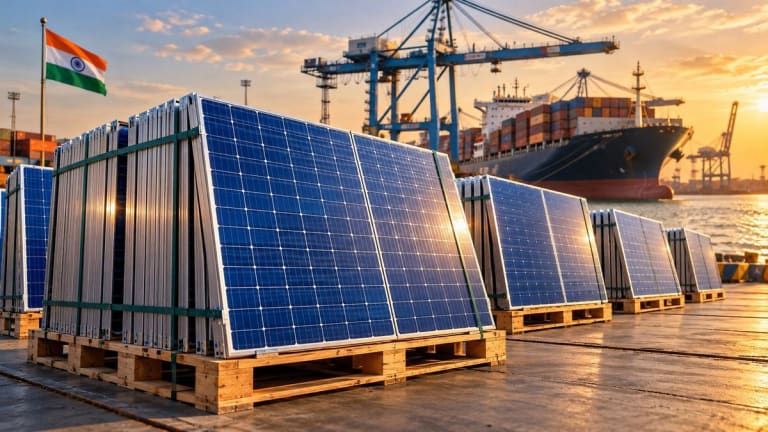
India is coordinating with the Exim Bank to diversify its solar and wind technology exports, targeting markets in Europe, Africa, and Latin America following U.S. trade restrictions.
The clean energy industry in India is searching for new commercial horizons. Faced with strict tariff barriers imposed by the United States, the Asian nation has intensified negotiations with the Exim Bank to finance the sale of photovoltaic equipment and wind turbines to other global regions.
This strategic move comes at a time of uncertainty for Indian manufacturers, who have seen the doors to the U.S. market close following investigations into dumping practices. The government’s current goal is to strengthen the Indian presence in emerging markets and the European Union by utilizing specialized credit lines to facilitate these deals.
The search for alternatives after U.S. sanctions
At the core of the tension lies the recent decision by the U.S. Department of Commerce, which set a dumping margin of 123.04% and subsidy rates exceeding 126% for solar cells produced in India. Although the process still awaits a final vote from the U.S. International Trade Commission, the restrictive landscape is already forcing an industry reorientation.
The Secretary of the Ministry of New and Renewable Energy, Santosh Kumar Sarangi, has been leading discussions with companies in the sector. The focus is on designing effective financial instruments that will make Indian products competitive abroad.
Indian companies are in dialogue with the bank to define which instruments can facilitate foreign sales and provide the necessary support for manufacturers to win over new buyers in Europe, Africa, and Latin America.
Competitive challenges and the role of the Exim Bank
Although the Exim Bank already has an established framework of credit lines for international governments and financial institutions, the current round of negotiations focuses on unlocking specific resources for the renewable energy sector. However, the path is not free of obstacles.
Beyond the need to structure solid contracts, India faces strong competition from China, which dominates the global solar equipment market with highly aggressive pricing. Sarangi acknowledges that penetration into new territories will depend on the Indian sector’s ability to balance state financial support with cost efficiency.
The horizon for India’s sustainable energy industry now depends on the agility of these agreements. While the legal timeline in the United States moves toward the next stage in 2026, India is banking on geographic diversification as the primary pillar to ensure the sustainability and continued growth of its cutting-edge technological production.