
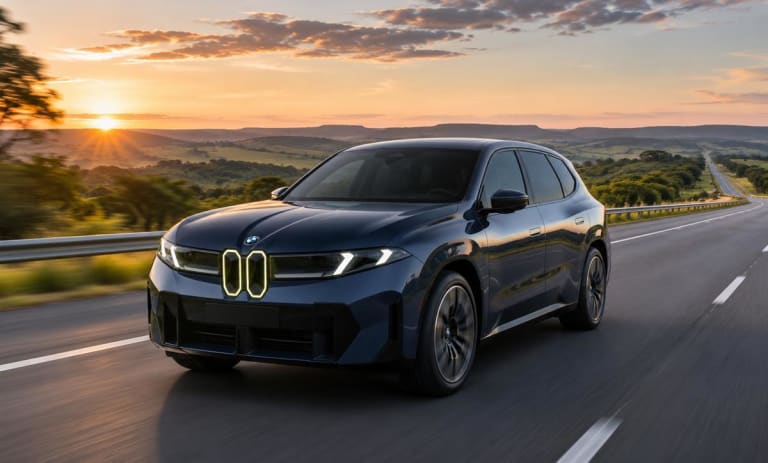
The new 2027 BMW iX3 electric SUV covered over 1,000 kilometers between Brasília and São Paulo on a single charge, setting an unprecedented energy‑efficiency record in Brazil.
The electric vehicle revolution has gained a new emblematic chapter on Brazilian roads. The new BMW iX3 2027 demonstrated the capability of its new technical platform by completing a long highway trip without needing to recharge the battery.
On a challenging route between Brasília and São Paulo, the German brand’s SUV traveled exactly 1,015.8 kilometers on a single full charge. The feat, officially announced on November 23, 2026, required almost 18 hours of driving and recorded an average consumption of 10.9 kWh per 100 kilometers.
Although the assessment was conducted under driving conditions focused on maximum economy, the result reflects advances in automotive engineering. The test highlights the maturity of new long‑range, zero‑emission projects.
Efficiency engineering and the Heart of Joy system
To surpass the thousand‑kilometer barrier, the expedition maintained an average speed of 57.1 km/h. The route required meticulous management of the energy stored in the cells installed beneath the vehicle’s floor.
The key technological differentiator in this process is the Heart of Joy system, an electronic hub that integrates the operation of the motors, brakes, and energy regeneration.
During decelerations and downhill sections, the kinetic energy generated by motion is converted into electricity and redirected back to the battery, extending real‑time usable range.
Despite the historic milestone achieved in the test, everyday range varies with speed, terrain, temperature, and driving style. In the domestic market, the official reference remains the Inmetro homologation, which sets a range of 570 kilometers. In the European WLTP cycle, the disclosed range is 805 kilometers.
800‑volt architecture and ultra‑fast charging
The BMW iX3 2027 marks the debut of the sixth generation of BMW eDrive technology, which adopts cylindrical battery cells integrated into the vehicle’s structure.
With a usable capacity of 108.7 kWh, the pack operates on an 800‑volt architecture. This engineering allows it to support DC charging powers of up to 400 kW.
At high‑power stations, the battery can recover from 10% to 80% of its capacity in about 21 minutes. Just ten minutes on the charger can add up to 372 km of range under the WLTP standard.
“The advancement in high‑voltage electric architectures dramatically reduces stop time on trips, making long‑distance driving far more practical.”
Sporty performance and enhanced aerodynamics
Marketed as the 50 xDrive M Sport version, the SUV balances the pursuit of efficiency with the traditional sporty DNA of the German manufacturer.
Two electric motors distributed across the axles deliver all‑wheel drive, a combined power of 469 hp and peak torque of 645 Nm (65.8 kgf·m).
This configuration allows acceleration from 0 to 100 km/h in 4.9 seconds, reaching a top speed of 210 km/h.
The body design was optimized to cut wind with minimal drag. Retractable handles, illuminated front grille, LED headlights, and a roof‑integrated spoiler help contain energy waste at highway speeds.
Digital cabin and functional space
Inside, the new visual language replaces the conventional instrument cluster with the BMW Panoramic iDrive system, which displays essential data along the windscreen base.
All other vehicle functions are controlled by a 17.9‑inch multimedia center, centralizing connectivity, navigation, and climate‑control settings.
The platform dedicated to electric models provides a flat rear floor and excellent interior utilization for five passengers.
The main trunk offers 520 liters of capacity, which can reach 1,750 liters with the seats folded. In the front, an additional 58‑liter compartment houses charging cables and small items.
Brazilian market and the Neue Klasse platform
Available through the Brazilian dealership network since September 2026 with an initial price of R$ 582,950, the model’s price was adjusted to R$ 587,950 in November 2026 for cash purchases.
As the first representative of the Neue Klasse architecture, the SUV paves the way for the brand’s upcoming crop of electric cars slated for the coming years.
The model, produced between the federal capital and São Paulo, showcases the technical potential of electric mobility in the country. To turn this performance into everyday convenience, expanding the ultra‑fast charger network along Brazil’s highways remains the next essential step.