
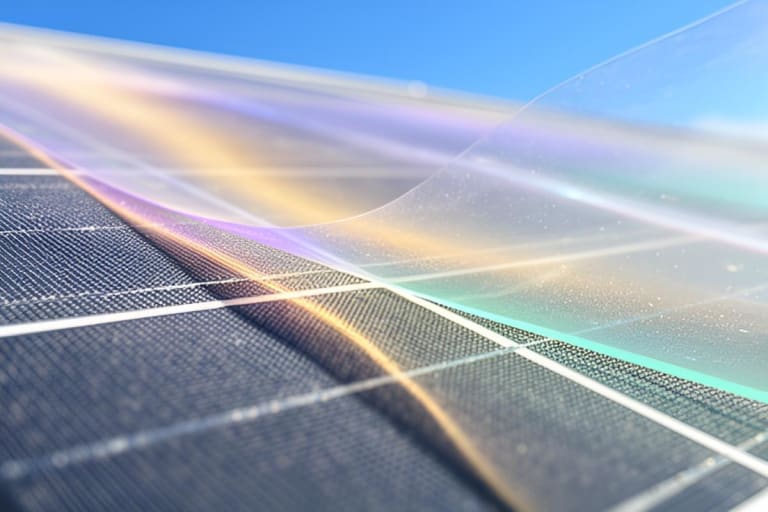
The new photoluminescent film developed by Anexo Energia promises to increase the efficiency of solar panels by 12%, using rare earth properties to convert radiation into electricity.
The quest for greater efficiency in the energy transition has just gained a new ally in Brazil.
The startup Anexo Energia, based in Goiás, in partnership with the Instituto Anexo, has developed an innovative film that promises to increase solar energy generation by up to 12% in already installed modules, offering a practical and efficient alternative for the photovoltaic sector.
The project, which received a total investment of BRL 4.4 million—with BRL 3.9 million provided by Finep (Studies and Projects Financer)—uses nanotechnology based on europium, a chemical element belonging to the rare earths.
The main proposal is to transform ultraviolet radiation, which would normally be wasted by silicon panels, into visible light that can be used for electrical conversion.
Technology That Optimizes the Solar Spectrum
The film, named QORA, acts as an active filter on the surface of the panels.
By performing photoluminescent conversion, the material not only increases energy production but also provides an extra layer of protection against wear caused by UV rays, a factor that can help preserve components over the years.
The technology was designed to optimize existing assets, allowing micro and distributed mini-generation plants to increase their performance without the need for heavy investments in hardware replacement or physical expansion of facilities.
Challenges and Market Expansion
Although laboratory tests indicate promising results, the next critical step for Anexo Energia is validating performance under real weather conditions.
The durability of the coating under prolonged solar exposure and the economic viability of the installation costs will be decisive for large-scale adoption.
Currently, Instituto Anexo is in the phase of prospecting industrial partners to bring the innovation to the national and international markets.
The solution has already been recognized with the Finep Innovation Award, reinforcing the technology’s potential within the decarbonization and energy security goals pursued by Brazil.
The success of the initiative will mark a significant advancement in the solar energy segment.
If the 12% efficiency is confirmed in the field, QORA could become a game-changer for investors and owners of photovoltaic systems who want to maximize the productivity of their current assets with competitive operational costs.
RELATED NEWS
 AXIA Energia Completes Black Start Tests at Strategic Northeastern Hydroelectric Plants
READ MORE
AXIA Energia Completes Black Start Tests at Strategic Northeastern Hydroelectric Plants
READ MORE
 Vallourec Advances Sustainability with Technology That Cuts Methane Emissions in Charcoal Production by Up to 99%
READ MORE
Vallourec Advances Sustainability with Technology That Cuts Methane Emissions in Charcoal Production by Up to 99%
READ MORE
 Peru inaugurates 403 MW hybrid complex uniting solar and wind power in Nasca
READ MORE
Peru inaugurates 403 MW hybrid complex uniting solar and wind power in Nasca
READ MORE