The severe wildfire season in Amazonas, intensified by the El Niño phenomenon, has left Manaus under a dense layer of pollution, forcing authorities to ramp up firefighting efforts across the biome.
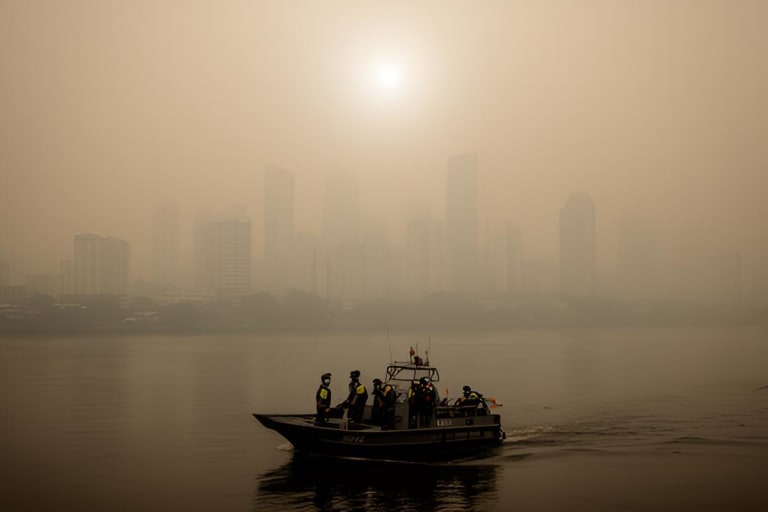
The capital of Amazonas is facing an unprecedented environmental crisis, with air quality reaching alarming levels due to the spread of smoke from fires in various parts of the state. This critical scenario forced the suspension of classes in the municipal school system and imposed strict respiratory protection guidelines for residents of Manaus, where visibility has been consistently reduced.
The federal government, working alongside environmental agencies, has recognized a state of emergency in 36 municipalities in Amazonas. The severity of the situation is attributed not only to human action, but also to the strengthening of El Niño, which has intensified the dry season in the Northern Region, leaving vegetation extremely susceptible to fire.
Task force in the heart of the forest
To contain the advancing flames, a large-scale operation was deployed, involving 290 firefighters and a fleet of 11 aircraft. Key equipment includes the Brazilian Air Force (FAB) KC-390 cargo aircraft, capable of dropping 12,000 liters of water per pass, alongside Ibama‘s Air Tractor planes, which operate in hard-to-reach areas.
Data from the Fire Panel of the Management and Operational Center of the Amazon Protection System (Censipam) reveal a 271% increase in hotspots during the first ten days of October compared to the same period in 2025. The complexity of firefighting lies in the fact that many fires are occurring deep within the preserved forest.
The Executive Secretary of the Ministry of Environment, João Paulo Capobianco, stated:
More serious than I imagined, because we identified many fire hotspots in the middle of the preserved forest. It is not just fire that was set in pastureland and spread into the woods.
Climate impacts and public health
The severe drought reduces forest humidity, turning organic matter into highly flammable fuel and hindering the dispersion of pollutants. According to the IQAir platform, the concentration of PM2.5 fine particulate matter in Manaus reached levels far exceeding those recommended by the World Health Organization (WHO), placing the capital at the top of the cities with the most polluted air in the country.
The Civil Police of Amazonas has already launched investigations into the criminal origin of several fire hotspots, registering dozens of police reports linked to environmental crimes in September alone. Meanwhile, the government maintains an active alert, recommending the use of masks and indoor isolation to protect the population.
The presence of firefighter teams in the state is guaranteed until the critical hotspots are definitively contained. Authorities expect that, with the task force in the field and constant aerial monitoring, control over the flames will be re-established, mitigating respiratory risks for isolated communities and the region’s biodiversity.