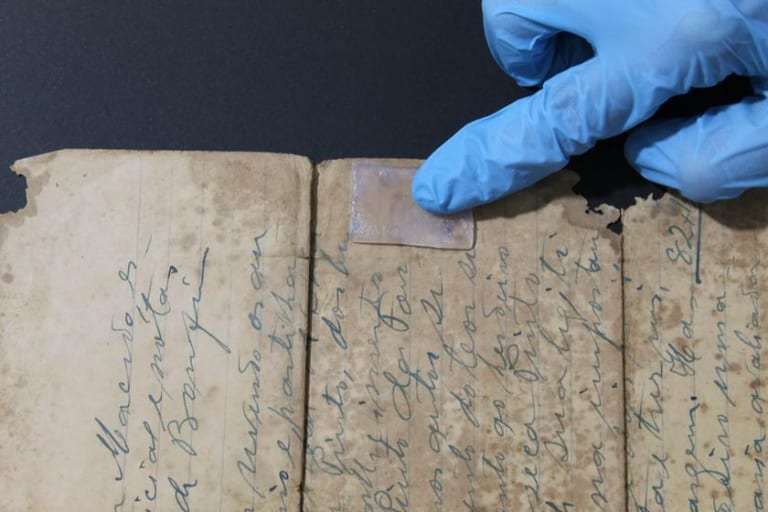
Researchers from Unicamp and UFMG develop innovative hydrogels from sugarcane bagasse, creating a sustainable, biodegradable, and precise solution for cleaning and conserving artworks and delicate surfaces.
The restoration of cultural heritage and artworks requires extraordinary technical precision. When conservators need to remove dust, residues, or degraded varnish layers, controlling the amount of water or solvent applied is critical to avoid damaging the original material. Excess liquid can penetrate deeply and compromise the structure of the piece, as well as evaporate quickly, exposing professionals to potentially toxic compounds.
To solve this challenge, Brazilian researchers combined biomass chemistry with historical preservation. The result is the development of sustainable hydrogels that use nanocellulose extracted from sugarcane bagasse as their primary raw material. The technology promises to transform traditional cleaning methods in clean energy and cultural heritage conservation, uniting technical efficiency and the circular economy.
The innovation emerged from a collaboration between chemist Camila Rezende, a professor at Unicamp‘s Instituto de Química, and conservator-restorer Camilla Camargos, a professor at UFMG. With a patent filed with the INPI and strategic support from the Agência de Inovação Inova Unicamp, the technology represents a significant advancement in protecting delicate surfaces using abundant renewable natural resources in Brasil.
How nanocellulose hydrogels work
The developed gels do not act as direct cleaning agents, but rather as smart delivery vehicles for the required fluids. They function as a three-dimensional porous network that retains water or solvents, releasing them gradually and in a controlled manner onto the surface of the artwork.
Camilla Camargos explains:
It acts as a platform for applying this cleaning fluid. Since the fluid is contained within the gel, it will not penetrate as deeply or affect layers that should be preserved.
This flexible and resilient structure prevents the solvent from reaching underlying layers of paintings or damaging porous materials, such as old paper and historic textiles. Furthermore, by limiting the volatility of the compounds, the method protects the health of conservators during handling.
Sustainability and national innovation
While the international market already relied on high-cost synthetic gels that were difficult to import, the new technology leverages local, biodegradable raw materials. The formulation combines nanocellulose from sugarcane bagasse with accessible biopolymers, such as gelatin and alginate (derived from seaweed).
The development process required years of research—beginning during an exchange program at the Universidade de Florença in Itália—until the Brazilian team succeeded in structuring a pliable material that is flexible enough to conform to surface contours and entirely free of harmful residues.
Next steps in cultural heritage conservation
With the technology patented and validated, the researchers are now aiming to further refine control over water release and gel flexibility for various textured surfaces. The initiative highlights how utilizing agricultural byproducts can generate high-value solutions for demanding sectors, bridging scientific innovation, historical preservation, and sustainability.