Aeris Tooling Solutions leverages advanced engineering to extend the lifespan of wind components, promoting a circular economy by preventing premature disposal and managing the efficient handling of tons of complex materials in the clean energy industry.
The rapid growth of the wind energy sector presents a crucial logistical and environmental challenge: how to manage the lifecycle of equipment and reduce the impact of decommissioning.
With Brazil solidifying a significant installed capacity of 35.9 GW, the industry is focusing on sustainable practices that go beyond energy generation, seeking to maximize the use of existing operational assets.
The circular economy has become the key to ensuring the sector’s sustainability.
Through engineering solutions focused on recovery and adaptation, companies like Aeris Tooling Solutions are transforming how components such as blades and nacelles are treated, preventing technically viable parts from being discarded prematurely.
Engineering as a Pillar of Sustainability
The application of technical expertise allows for the assessment of each component’s condition, identifying whether a part can be recovered, adapted, or partially replaced.
This approach reduces the reliance on new inputs and optimizes the resources already allocated to the national wind farm fleet.
Cezar Rogerio Borges, Corporate Development Engineering Manager at Aeris Tooling Solutions, stated:
“The circular economy in the wind industry doesn’t just begin when a component reaches its disposal stage. There’s a prior step where engineering can assess if that asset can still be recovered, adapted, or partially replaced. Extending its use, when technically possible and safe, means making better use of the resources already invested and also generating operational efficiency.”
Challenges in Recycling Composite Materials
One of the biggest obstacles to wind energy sustainability is the management of composite materials, such as the fiberglass and carbon fiber found in turbine blades.
Unlike metal parts, which have an established recycling chain, composites require more complex technologies for proper processing.
To mitigate this impact, Aeris Tooling Solutions has been directly involved in waste management.
The company has already managed the correct disposal of approximately 221 tons of wind turbine blades, applying rigorous processes that seek alternatives beyond landfills, aligning with global sustainability goals adopted by markets like Europe.
Outlook for the Wind Sector
The demand for recovery solutions is expected to grow as the installed base of wind turbines ages.
With the Brazilian Association of Wind Energy and New Technologies (ABEEólica) monitoring the evolution of over 12,000 wind turbines in Brazil, technical innovation will be crucial for a conscious energy transition.
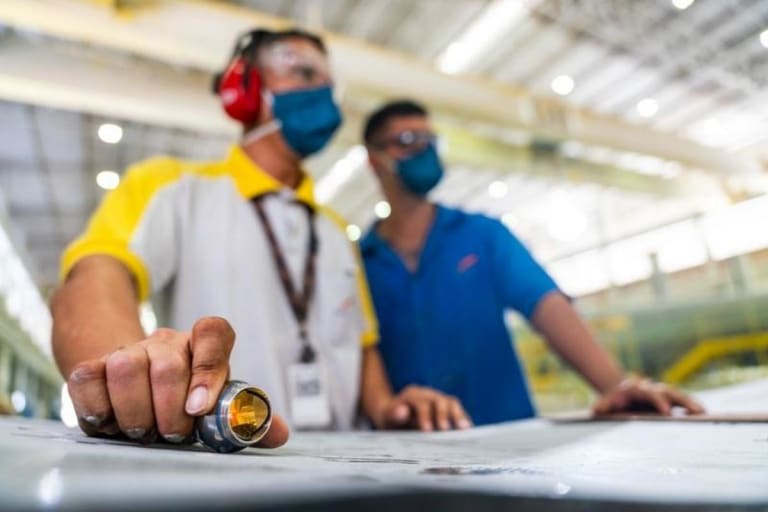
By integrating engineering, metrology, and customized manufacturing processes, the sector not only reinforces its commitment to decarbonization but also establishes a more efficient business model.
The continuation of this work ensures that wind energy remains one of the most sustainable and innovative pillars of the global energy matrix, transforming the challenge of waste into a new opportunity for operational efficiency.