
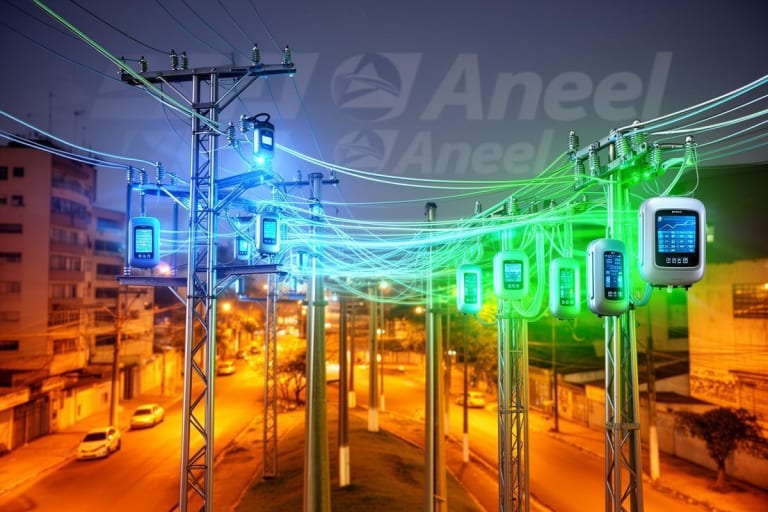
New Aneel Rules Could Impact 33 GW of Distributed Generation, Requiring Technological Adaptation and Increased Distributor Control.
The National Electric Energy Agency (Aneel) is on the verge of proposing new guidelines that promise to redefine the operation of distributed generation in Brazil. The agency’s technical team has suggested the implementation of strict monitoring and control requirements for all new distributed energy projects, as well as significant adaptation of existing assets totaling over 33 gigawatts (GW). This regulatory change aims to prepare energy concessionaires for a more proactive role in grid management, bringing them closer to the Distribution System Operator (DSO) model.
The proposal, which is moving towards public consultation, covers approximately 68,000 microgeneration units and 1,500 Type III distributed generation plants. These systems, which already represent a significant portion of the installed distributed generation capacity, will need to adapt to allow for more refined control by distributors. The change signals an evolution in how energy is managed, anticipating future challenges with the exponential growth of decentralized renewable sources.
Expanded Operational Control by Distributors
Aneel’s proposal is ambitious and foresees distributors assuming more direct control over the energy resources connected to their grids. Under the new rules, concessionaires will be responsible for monitoring real-time data and issuing commands to assets under their jurisdiction. This new capability will enable more effective coordination with the National Electric System Operator (ONS), translating the system’s needs into concrete actions at distributed generation facilities.
This regulatory update is seen as a crucial step for distributors to expand their role as true distribution system operators. Currently, many face a visibility deficit regarding the behavior and production of millions of devices located downstream from energy meters. The intention is to build a technical structure that supports the DSO model, although more complex issues, such as functional separation and remuneration for this new activity, still need to be detailed.
What Changes for Plant and Microgeneration Owners
Existing microgeneration units, defined as systems with power above 75 kW and up to 5 MW, will be the main focus of the adaptation. The 4.31 million microgeneration systems, while representing the vast majority of units, will be exempt from the mandatory requirements but may voluntarily adhere to the new standards.
The technological adaptation will be divided: distributors will handle the communication infrastructure between their operation centers and user connection points, defining protocols and ensuring cybersecurity.
On the other hand, plant and microgeneration owners will be responsible for installing and maintaining internal equipment that allows integration with the distributor’s infrastructure. This includes protocol compatibility and ensuring that systems respond adequately to received commands.
Aneel considers this adaptation technically feasible, assuming that medium-to-large scale installations possess the technical and financial capacity for it. Implementation is expected to be phased, starting with Type III plants.
Preparing the Grid for the Future of Energy
The regulatory review is not limited to existing assets but also establishes requirements for all new distributed energy resource connections. This concept includes not only generation but also energy storage systems and loads with consumption modulation capacity. The proposal, developed based on contributions from the ONS and academic institutions, addresses crucial aspects such as protection, response to voltage and frequency variations, active and reactive power control, power quality, islanded operation, and equipment certification.
The alert regarding the impacts of distributed generation expansion, especially during periods of low demand and high solar and wind production, has been issued by the ONS since 2025. The demand for greater coordination and control instruments led to the development of an emergency plan by the operator. Aneel’s new regulation thus emerges as a strategic response to these challenges, aligning the country with global advances in smart grid management and driving the transition to a more resilient and efficient energy system.
RELATED NEWS
 ANEEL Upholds Consortium ION’s Disqualification After Financial Requirements Review for Auction
READ MORE
ANEEL Upholds Consortium ION’s Disqualification After Financial Requirements Review for Auction
READ MORE
 ANEEL Maintains Consortium ION’s Disqualification in Capacity Reserve Auction
READ MORE
ANEEL Maintains Consortium ION’s Disqualification in Capacity Reserve Auction
READ MORE
 ANEEL upholds disqualification of Consórcio ION from capacity reserve auction due to financial shortcomings
READ MORE
ANEEL upholds disqualification of Consórcio ION from capacity reserve auction due to financial shortcomings
READ MORE