Germany has completed construction of its innovative 365-meter wind turbine, which promises to double energy generation by reaching stronger winds at an altitude of 300 meters.
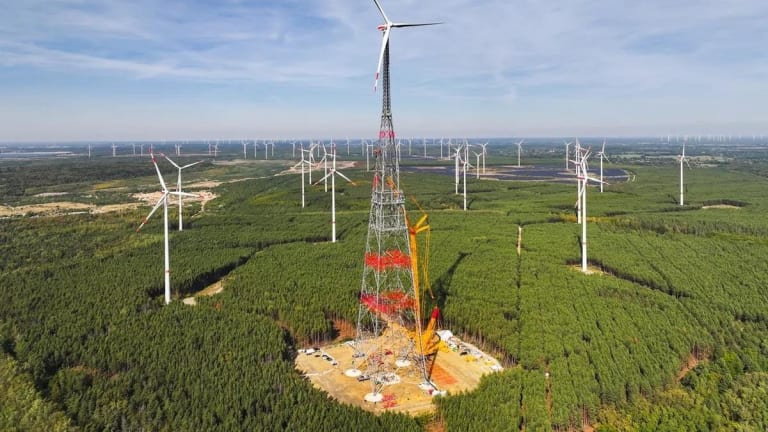
German engineering has reached a new milestone in the energy transition sector. In the town of Schipkau, the company GICON has finalized the assembly of an impressive 365-meter tall structure, surpassing global icons like the Eiffel Tower.
With the hub height positioned at 300 meters above the ground, the primary objective is to capture significantly more intense and consistent wind currents. This approach promises to drastically increase the efficiency of onshore installations.
Despite the architectural impact, the true capacity of the 3.8 MW turbine will only be put to the test on November 19, the confirmed date for its inauguration and the start of operations.
Innovative engineering and lifting without massive cranes
Erecting a structure of this scale required ingenious solutions. Instead of traditional solid steel or concrete tubes, GICON developed a modular lattice tower that utilizes over 2,000 tons of steel.
Since there are no cranes on the market capable of lifting generators to an altitude of 300 meters, the team adopted a telescopic system. The turbine was assembled at a lower height and then hoisted to the top using steel cables.
The management of GICON highlighted during the technical adjustment phase of the project:
Safety and quality are the absolute priorities in the execution of this project.
The project is funded by the federal agency SPRIND, which is betting on this technology to bolster the country’s energy independence and optimize existing infrastructure.
Yield promises and debate over the numbers
The main theoretical promise is to generate up to double the energy of a conventional structure of the same size. Preliminary measurements in the region indicate significantly higher wind potential at this altitude.
Even so, the published annual production data has sparked technical debate. Projections range from a floor of 18 million kWh to more ambitious targets of up to 33 GWh.
The practical performance of the turbine, provided by the manufacturer Vensys, will provide a definitive answer once the system is fully integrated into the power grid.
Technological gap and the landscape in Brazil
The wind sector in Brazil currently operates with quite different parameters, utilizing wind farms with operational towers measuring between 80 and 120 meters in height.
The most ambitious national project is planned for São Gonçalo do Amarante, in Ceará. A partnership between Casa dos Ventos and Goldwind plans a structure totaling 257 meters.
Both in Europe and South America, transport logistics and the availability of hoisting equipment remain the greatest challenges for the advancement of super-towers.
The future of the ‘wind second floor’
If the prototype in Schipkau demonstrates the expected efficiency, GICON intends to produce the technology at a commercial scale for application in various countries.
The German government’s goal is to install up to 4,000 towers of this type, using a ‘second floor’ model that utilizes the airspace of already existing power plants without occupying new land.
Next steps include the application of generators with a capacity exceeding 7 MW, consolidating a new era for renewable energy generation on the planet.