
Brazil emerges as a global leader in biofuel expansion, projecting sustainable growth that doesn’t compromise food security through smart land use and technological innovation.
The growing global demand for clean energy and the urgency to decarbonize the world’s energy matrix position biofuels as a strategic alternative to fossil fuels. This transition, crucial for mitigating greenhouse gas emissions, often raises a critical debate: the potential competition for agricultural land between food production and biomass for energy. However, Brazil, with its vast territory and resources, presents a promising path to overcome this challenge.
In this scenario, the country stands out as a central player, with a unique potential to significantly increase the supply of sustainable biofuels. Experts point out that this expansion can occur without any prejudice to the population’s food security, transforming Brazil into a model of energy and agricultural sustainability.
The Potential of Degraded Pastures
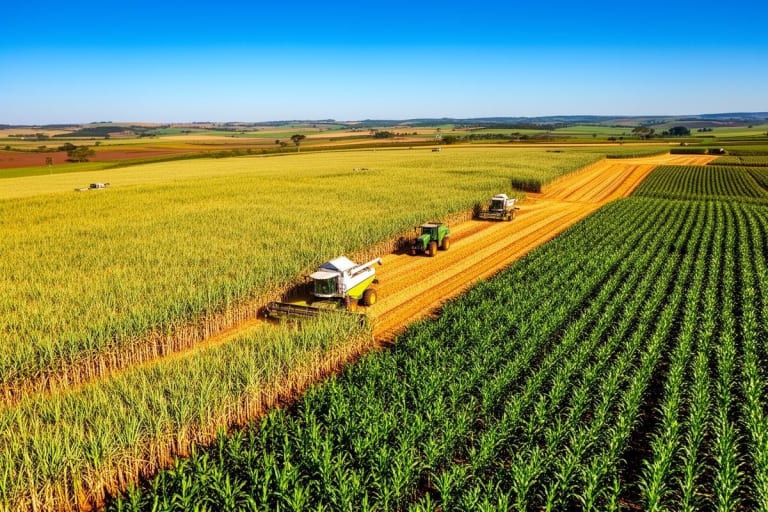
According to David Tsai, a chemical engineer and project manager at IEMA (Institute for Energy and Environment), the concern about land disputes is not a fatality in the Brazilian context. The country has approximately 100 million hectares of degraded pastures, an area that represents an immense opportunity. A significant portion of this land can be recovered and used for both agriculture and bioenergy production, avoiding the need to encroach on forests or areas already used for food cultivation.
As Tsai points out,
“Productivity gains in agriculture and livestock farming allow us to produce more on less land.”
He emphasizes that the problem arises from disorderly expansion, extensive monocultures, or indirect pressure on deforestation.
“The discussion is not just food versus fuel, but how to organize land use with planning, environmental conservation, and increased productive efficiency.”
Innovation and Management for Sustainability
For the production of biofuels not to compete with food production, the main strategy lies in concentrating expansion in areas already converted for agricultural use. Sectoral studies reiterate the effectiveness of integrated systems, such as ILPF (Crop-Livestock-Forestry Integration), no-till farming, and agroforestry systems, which optimize land use and increase productivity.
Another fundamental pillar is technological advancement in production. The growing adoption of 2nd generation biofuels, which use byproducts such as straw, bagasse, and other agricultural and urban waste, drastically minimizes the demand for new cultivable areas. This innovation is crucial for diversifying the country’s energy matrix, driving the energy transition more efficiently.
Public Policies and Strict Criteria
David Tsai highlights that the mere existence of technology is not enough; it must be complemented by effective public management and well-defined policies. The implementation of rigorous socio-environmental criteria, traceability of production chains, and the development of public policies that harmonize food security, environmental conservation, and the energy transition are essential.
With this integrated approach, Brazil is capable of consolidating its leadership position in bioenergy, expanding the production of biofuels without compromising the vital production of food. The path to a greener and more energetic future lies in intelligent land use and innovation, ensuring truly sustainable development.