Discover how choosing the right solar mounting structure for colonial roofs ensures durability, prevents issues, and protects your investment in clean energy.
The solar energy landscape in Brazil shows robust growth, with over 4.3 million distributed generation systems connected to the grid by April 2026. Of this total, an impressive 84% are installed in residences, many of which feature traditional colonial roofs with ceramic tiles. However, the success of this expansion critically depends on the quality of the solar installation, especially regarding the panels’ mounting structure.
Despite their popularity, poor execution or the improper choice of solar mounts for these types of roofs can lead to a series of problems, such as broken tiles, leaks, and structural failures. The most important point is that ceramic tiles, by their nature, were designed for sealing, not for bearing weight. Therefore, the key to an effective and safe installation lies in correctly anchoring the system directly into the roof’s wood framing, ensuring the safety and durability of the photovoltaic system.
The Importance of Z-Type Hooks and Their Adjustments
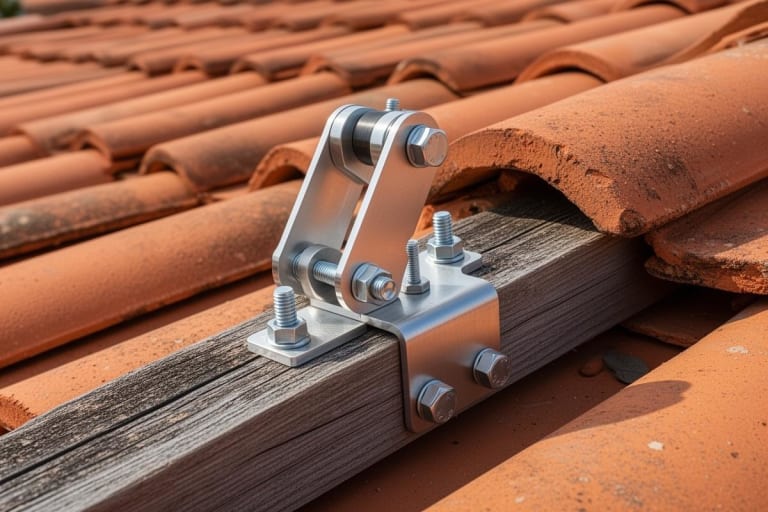
For colonial roofs, the most reliable mounting method is the use of the Z-type hook. This component is designed to be directly fastened to the roof’s structural elements, such as rafters or purlins, without requiring tiles to be cut. The tile is carefully lifted, the hook is anchored to the wood framing, and then the tile returns to its original position, with the hook contouring around it and receiving the aluminum rail that will support the solar module.
A common error that compromises the installation’s durability is the lack of height adjustment on the hook. If the hook doesn’t allow for this adjustment, the tile may end up resting on it instead of returning to its original support, improperly turning it into a load-bearing element. This design flaw can lead to cracks and broken tiles weeks or months after assembly, mainly due to thermal expansion, maintenance, or strong wind gusts, resulting in additional costs and customer dissatisfaction.
Avoiding Critical Mounting Errors
Beyond the lack of height adjustment, other common mistakes occur when mounting on colonial tiles. Hook positioning is crucial: it must be installed on the high part of the tile wave, near its support point, and never in the trough, which is where water drains. Fastening to battens instead of rafters or purlins is also a serious error, as battens do not provide the necessary structural support.
NBR 7190-1 establishes criteria for sizing and connections in wood, and it is crucial that the existing wood framing be evaluated. Older roofs were rarely designed to support the additional weight and stresses of a photovoltaic system. The condition of the wood, including age, moisture, and signs of termites, must be checked even before the budget is prepared, and not just during the installation phase, to ensure the structure’s safety.
Wind as a Decisive Factor in Sizing
Contrary to popular perception, the weight of photovoltaic modules (approximately 12 to 15 kg/m²) is relatively modest and rarely the determining factor in the sizing of the mounting structure. The element that truly matters is the uplift force caused by wind. NBR 6123, the standard addressing wind forces on buildings, indicates that pressure and suction coefficients are significantly higher at the edges and corners of the roof.
A solar module installed near the roof eaves, for example, will be subject to much more intense uplift forces than a module positioned in the center. This explains why there isn’t a universal rule for ‘how many hooks per module.’ The quantity and spacing of mounting points depend on factors such as geographical region, building height, roof geometry, and the strength of the connection to the wood framing. Prioritizing material savings by reducing mounting points is a high-risk decision that can lead to incidents.
The Ideal Structure for Colonial Roofs and the Importance of the Technical Data Sheet
A quality mounting structure for colonial roofs must be adaptable to the variability of tile profiles, wave heights, and inclinations, in addition to accommodating irregular rafter spacing. The company Pratyc, for example, has developed a product line that includes a base directly fastened to the wood framing and a Z-hook with height adjustment, which absorbs differences between tile profiles, along with M8 carriage bolt locking to prevent displacement.
Material compatibility is also vital. Direct contact between aluminum profiles and untreated steel fasteners can lead to galvanic corrosion, a serious problem, especially in coastal regions. Therefore, the best structure is one that offers height adjustment on the hook, effective anchoring to the wood framing, wind-load sizing declared in accordance with NBR 6123, and compatibility between aluminum and fasteners. It is essential that the supplier’s technical data sheet details the supported wind speed and the maximum spacing between mounting points—crucial information for the integrator’s responsibility.
Insurance and Post-Sales Risk Management
Recognizing the inherent risks during the installation and post-assembly phases, companies like Pratyc have innovated by including automatic insurance in their roofing kits, the Seguro Pratyc. With 90 days of coverage from the invoice date and a limit of up to R$20,000 per structure, it protects customer assets against damages during and after installation, with a 20% deductible.
This insurance covers common incidents during the critical construction period, such as broken tiles from team traffic, leaks discovered after the first rain, or damage to customer property. While it doesn’t replace correct specification and sizing—as failures due to hooks without adjustment often emerge after this period and are not covered by a poorly designed project policy—it alleviates the integrator from immediate financial risk. The choice of mounting structure, therefore, transcends engineering; it is a fundamental commercial risk management strategy that directly impacts reputation and success in the clean and sustainable energy market.