The 4th Cycle of the Permanent Offer for Production Sharing raised R$ 530.5 million in bonuses, highlighting the operational synergy strategy adopted by the winning oil companies.
The National Agency of Petroleum, Natural Gas and Biofuels (ANP) consolidated a landmark event for Brazil’s production sharing regime this Wednesday.
During the public session of the 4th Permanent Offer Cycle (OPP4), seven areas were auctioned off, revealing a clear trend among oil companies: the pursuit of assets located near fields where they already have established operations.
Although all blocks were acquired through individual bids—without direct competition between companies for the same block—the event was celebrated as a technical success.
The strategy of investing in areas contiguous to operational assets allowed companies to offer aggressive premiums on the oil surplus, reaching levels of nearly 500% above the minimum required by the tender.
Operational synergy as an investment driver
The case of Prio is emblematic of this new dynamic.
For the first time under the production sharing regime, the company secured two blocks, Magnetita and Hematita, in the Campos Basin.
The geographical proximity to the Wahoo and Frade fields, where the oil company already holds full operations, was the key differentiator.
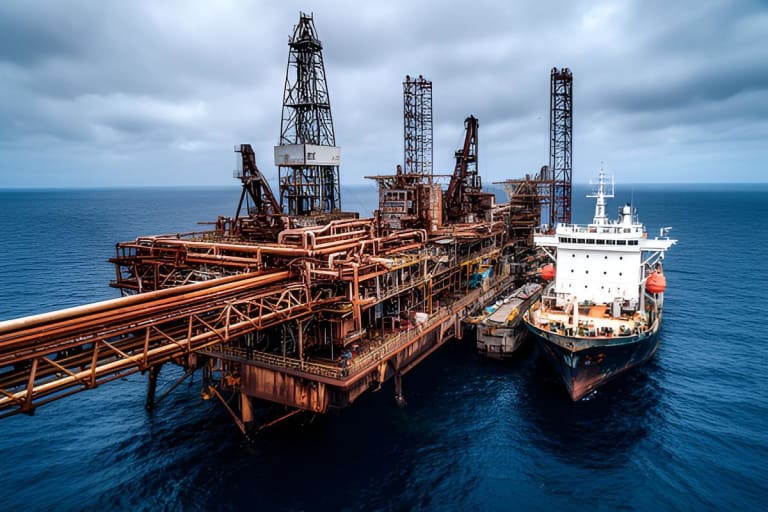
The concept is to use tie-backs, connecting the new wells to existing infrastructure, which drastically reduces the investment required for new platforms.
Regarding this move, the president of PPSA (Pré-Sal Petróleo SA), Luis Fernando Paroli, highlighted the financial efficiency of the model:
“Perhaps the stand-alone potential isn’t enough, but for a tie-back, it works very well and provides a very good margin, which also explains the premiums. Since the necessary investment is much lower, the company is able to offer a better premium than what the government expected.”
Results by company and the role of Petrobras
Equinor also followed the integration logic, acquiring the Rodocrosita block in the Santos Basin, near the Bacalhau field, which it operates in partnership with ExxonMobil and Petrogal Brasil.
According to Leticia Andrade, the company’s vice president of Asset Management, technical familiarity with the region facilitates the capture of future operational synergies.
Additionally, the company acquired the Rubi block, which has potential for independent development.
Petrobras maintained its presence in the auction by securing the Azurita and Cruzeiro do Sul blocks.
However, the industry was surprised by the lack of bids for the Opala block.
Even though it is located near Búzios, the country’s largest producing field, the asset did not generate immediate interest, which PPSA attributes to strategic capital allocation choices and the operational priorities of major operators.
With R$ 530.5 million raised in signing bonuses and a minimum investment commitment for the exploration phase estimated at R$ 778.4 million, the 4th OPP Cycle reinforces the sector’s viability.
PPSA‘s expectation now is to reevaluate the blocks that did not receive bids, while the winning companies begin planning to integrate their new findings into their already consolidated production portfolios.