
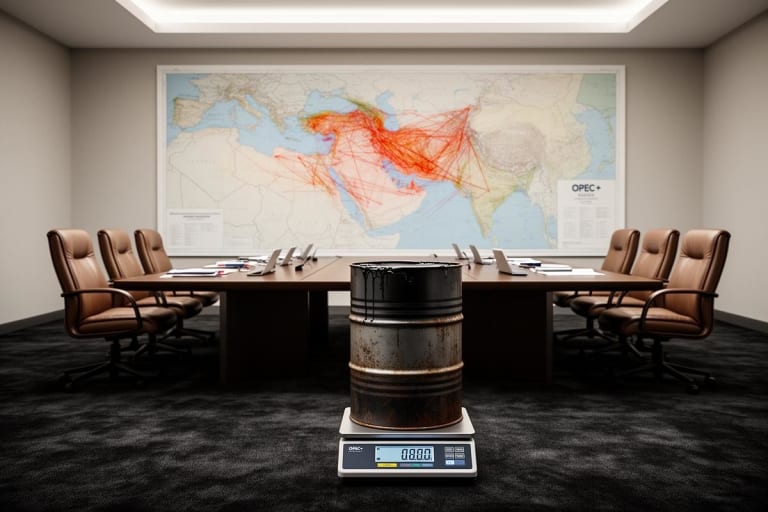
OPEC+ keeps oil production quotas unchanged for October, demonstrating commitment to global energy market stability despite rising geopolitical tensions in the Middle East.
The Organization of the Petroleum Exporting Countries and its allies, known as OPEC+, announced its decision to maintain oil production quotas without changes for the month of October. The consensus was reached during a monthly video conference, bringing together the seven main countries of the coalition led by Saudi Arabia and Russia, held this Sunday (September 6, 2026).
This measure is fully aligned with the alliance’s predefined strategy, which aims to ensure the stability of oil production targets until the end of the year. The maintenance of quotas occurs in a highly complex context in the Middle East, where geopolitical tensions significantly impact the region’s production capacity and exports, affecting the dynamics of the global energy market.
Stability Amid Regional Turbulence
The unstable scenario in the Middle East, marked by conflicts and tensions involving the United States and Iran, has led to substantial disruptions in oil production. The shutdown of part of the operations and the reduction of exports from Persian Gulf countries are direct reflections of destabilization, especially due to the interruption in the crucial Strait of Hormuz, a vital route for global hydrocarbon trade.
Despite external pressures, OPEC+ reaffirms its commitment to the continuity of its supply policies. The stability of quotas seeks to prevent sharp fluctuations in barrel prices and ensure a predictable supply for global consumers, contributing to energy security in uncertain times.
Commitment and Constant Monitoring
In an official statement, the group highlighted its unity:
“The 7 countries reiterated their collective commitment to achieve full conformity with the Declaration of Cooperation. The 7 OPEC+ countries will continue to hold monthly meetings to analyze market conditions.”
This statement underscores the alliance’s determination to adhere to established agreements, maintaining continuous monitoring of oil market conditions. OPEC+ members, including Saudi Arabia, Russia, Iraq, Kuwait, Kazakhstan, Algeria, and Oman, work together to calibrate supply according to global demand, directly influencing the world economy and the transition to sustainable energy sources.
In August, the coalition had already approved an increase in oil production quotas, with an additional 188,000 barrels per day, demonstrating its ability to adjust to the needs of the global energy market when deemed necessary. The decision to maintain quotas in October reflects a stance of caution and stability in the face of current challenges.
Impact and Future Outlook
The maintenance of production quotas by OPEC+ sends a clear signal of stability to energy markets. At a time of geopolitical tensions and economic volatility, this decision can help mitigate uncertainty regarding the supply of oil, a resource still essential to the global economy. The alliance’s ability to adhere to its planned schedule, even under pressure, demonstrates effective coordination among member countries.
Looking ahead, the monthly meetings of OPEC+ will continue to be key points for energy sector observers. Future analyses of market conditions will be crucial to determine subsequent steps, especially as the world moves towards a future of clean energy and demand for traditional sources adapts to new consumption realities and energy transition.