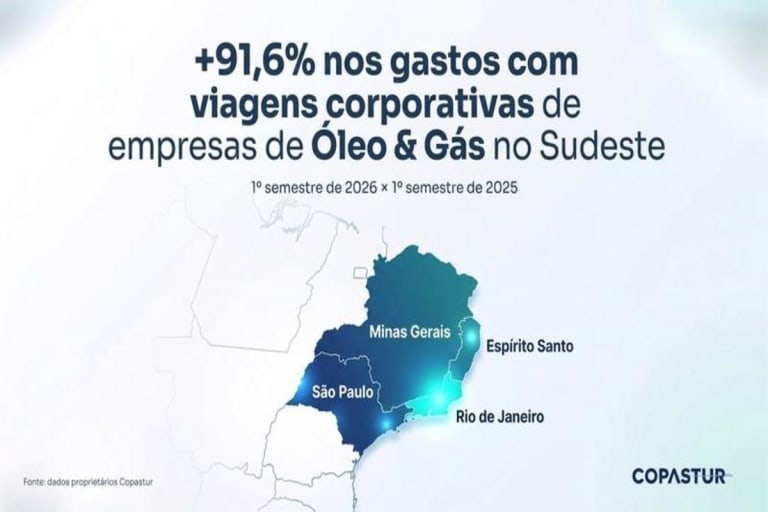
Oil & Gas Companies See Corporate Travel Surge in Southeast Brazil, Driven by Rio de Janeiro Market. 91.6% Growth Highlights Sector Expansion and Increasing Complexity in Mobility Management.
The Oil & Gas sector in Southeast Brazil has witnessed a remarkable increase in its corporate travel operations. Between January and June 2026, a period of just six months, spending on business travel in this segment registered a significant 91.6% increase compared to the same period of the previous year.
This expansion, according to a survey by Biosfera Copastur, places the sector among those that most boosted the corporate travel market, reflecting the dynamism and increasing activity in the national oil industry.
The survey by Biosfera Copastur, an agency with over five decades of experience in travel management and an international presence, highlights that this growth is concentrated in Rio de Janeiro, the epicenter of oil and gas production in Brazil.
The state not only leads national production but also accounts for a significant portion of Rio de Janeiro’s exports, moving billions of dollars. This economic relevance directly translates into an increased need for corporate mobility, with new explorations and the optimization of production units in full swing.
Sharp Growth in Rio de Janeiro: A Reflection of the Sector’s Dynamism
The scenario in Rio de Janeiro mirrors the global heating up of the Oil & Gas sector. In 2025, the state consolidated its position as a leader in oil and natural gas production, serving as a fundamental driver of Rio de Janeiro’s exports.
The prospect of continuous expansion, fueled by new projects and the intensified use of existing facilities, projects an even more dynamic future for the segment. This natural growth in the energy sector demands an adequate response in terms of mobility, making corporate travel an increasingly crucial component of business strategy.
The expansion of the Oil & Gas production chain, which involves various cities, production units, operational bases, and a vast network of suppliers and specialized teams, poses significant challenges for corporate mobility management.
The increase in the number of trips is only one facet; the true complexity lies in the need for meticulous planning, strict control, and an agile capacity to adapt to unforeseen circumstances. This reality requires companies in the sector to rethink their approaches to ensure efficiency and resource optimization.
Strategic Planning: The Key to Optimizing Corporate Travel Costs
Edmar Mendoza, CEO of Biosfera Copastur, emphasizes the importance of analyzing travel growth within the context of the highly complex Oil & Gas sector.
Mendoza states:
We are not just talking about increasing the number of trips, but about operations distributed across different projects, locations, and teams. The greater this complexity, the greater the need to transform data into planning, control, and response capability.
This view underscores that corporate travel management transcends mere logistics, becoming a strategic tool for overall management.
A crucial finding from the Copastur survey is the direct relationship between advance planning and cost savings in corporate travel. Tickets purchased more than 30 days in advance showed a significantly lower average cost of R$ 919.53.
In contrast, tickets purchased last-minute, between zero and nine days before departure, cost an average of R$ 2,171.64, an alarming 136% increase. For large-scale operations in the Energy sector, the difference is even more tangible.
Copastur conducted a simulation demonstrating the financial impact of more advance planning. Increasing the average ticket purchase lead time from 17 to 25 days could result in a reduction of the average ticket price from R$ 1,804.61 to R$ 1,363.02, generating potential savings of R$ 1.19 million for the company.
According to Mendoza, managing corporate travel in complex operations must be viewed as a strategic decision, where analyzing travel patterns and anticipating decisions identify opportunities for cost reduction and optimization of recurring trips.
Brazil Stands Out in Global Business Travel Landscape
The robust growth in the national energy sector aligns with a global trend of a warming business travel market. Data from the Global Business Travel Association (GBTA) projects a 13.8% increase in corporate travel spending in Brazil in 2026, totaling US$ 35.8 billion.
This expansion rate is the highest predicted among the 15 largest global markets, which, in turn, are expected to register a 7.2% growth, reaching US$ 1.71 trillion in investments.
The CEO of Biosfera Copastur emphasizes that true efficiency does not lie in attempting to anticipate all trips, as emergency demands are inherent to the Oil & Gas sector. Significant gains come from the ability to identify which trips can be planned, map consumption behavior, and employ technology and data intelligence to act strategically.
Mendoza concludes:
Efficiency is not necessarily about trying to anticipate all trips. In a complex operation, some demands are naturally urgent. The gain comes from understanding behavioral patterns and using technology to achieve agility, without sacrificing control and predictability where they are possible.
The future of corporate travel management in the energy sector points toward an increasing integration of planning, technology, and data analysis.