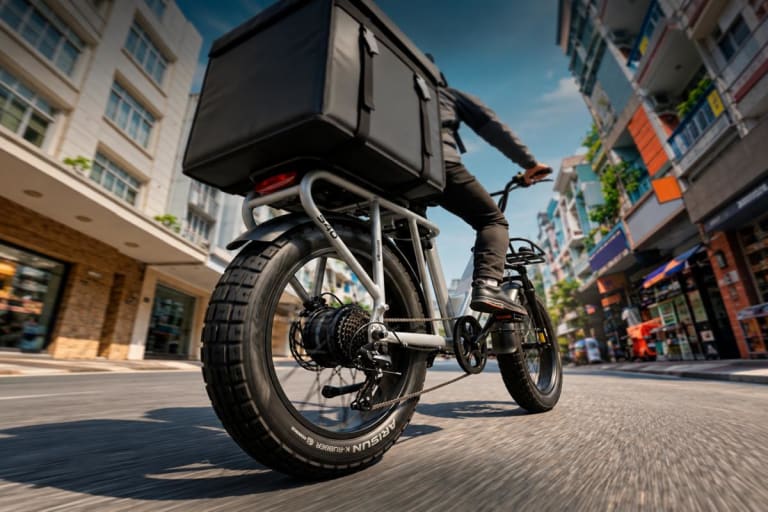
The Move Brasil program simplifies the acquisition of electric bicycles for delivery workers by offering credit with no down payment and reduced interest rates, boosting sustainable mobility and the green economy.
For those who use a bicycle as a work tool, investing in an electric model can be a game-changer for their delivery routine. The motor’s assistance reduces physical exertion on inclines and during long routes, while also helping maintain a steady pace throughout the workday. However, the high initial cost can hinder access to such vehicles, especially for professionals who rely on delivery income to cover their daily expenses.
To facilitate this investment, the Federal Government introduced the Move Brasil program, which allows delivery and two-wheeled transport professionals to finance new electric bicycles with lower interest rates and no down payment requirements. One of the primary requirements for participation is that the equipment must be manufactured domestically, a criteria met by StreetGo, YOO Mobility, and OGGI—brands under OX Bike that have now joined the program.
This initiative strengthens the clean energy and active transport market, promoting efficient alternatives for urban centers. With the electrification of delivery fleets, the sector is moving toward greener practices, reducing the carbon footprint of the urban sustainability ecosystem.
Domestic Models and Technical Support
The three brands offer eight product options: five StreetGo models (S12, S14, S17, S27, and S40), the YOO Y200 and Fleek, and the OGGI BW 8.0, which is available in sizes S, M, and L. According to the company, two additional models are currently in the qualification process. The equipment features various configurations to meet the mobility needs of professionals, with ranges of up to 70 kilometers per battery charge for StreetGo models, depending on usage conditions.
The mandate for domestic production also addresses a critical concern for those using bicycles professionally: the availability of maintenance and spare parts. Unlike occasional use, a mechanical or electrical issue can prevent a delivery worker from working until the equipment is repaired, making technical support a decisive factor in choosing a vehicle.
All three brands manufacture their products at the Manaus Industrial Pole, where OX Bike operates a proprietary 70,000-square-meter plant. The company also maintains its own engineering team, distribution centers, stores, retailers, and repair shops across all Brazilian states, along with warranty services, technical support, and spare parts supply.
“For those who work on two wheels, the bicycle is an income-generating tool. Financing facilitates the purchase, but professionals also need to find assistance and spare parts when necessary. We have domestic production and a service network that supports customers after the sale.”
— David Peterle, CEO of OX Bike
Beyond reducing physical strain, electrification can help lower operating costs for delivery workers. Unlike combustion vehicles, electric bicycles eliminate daily fuel expenses. Furthermore, when they meet the categories established by CONTRAN Resolution No. 996/2023, they are exempt from driver’s license, registration, and licensing requirements.
Who Can Participate in the Program?
The program is available to delivery cyclists who have been registered on app platforms for at least six months and have completed at least 100 trips or deliveries. Professionals employed under formal contracts (CLT) are also eligible, provided they have at least six months of tenure at the same company.
The process begins at an authorized store, which prepares a quote with the professional’s data and the chosen bicycle. With the proposal in hand, the worker must register on the official Federal Government platform at gov.br/movebrasil to undergo an eligibility assessment.
The results of this step are provided within 10 business days. If requirements are met, the professional must contact a participating financial institution to request the financing. For electric bicycles, credit can be requested from Caixa Econômica Federal or Banco do Brasil, with approval subject to the institution’s credit analysis.
Once approved, the worker presents the letter of credit to a store carrying the authorized models. After the invoice is issued and the bank process is complete, payment to the retailer is made within five business days. Each beneficiary is eligible to finance one new bicycle through the program.
“Domestic production is what allows our brands to participate in Move Brasil. At the same time, it is linked to an engineering, distribution, and after-sales structure built to serve the Brazilian market. For the delivery worker, this means having access to financing and relying on local support while using the bicycle.”
— David Peterle
The consolidation of public policies aimed at energy transition and sustainable transport represents a significant advancement for Brazil’s green economy. Facilitating credit for two-wheeled clean energy points toward a future where metropolitan areas will benefit from more efficient, quiet, and eco-friendly delivery services, benefiting both the professionals and the environment.