
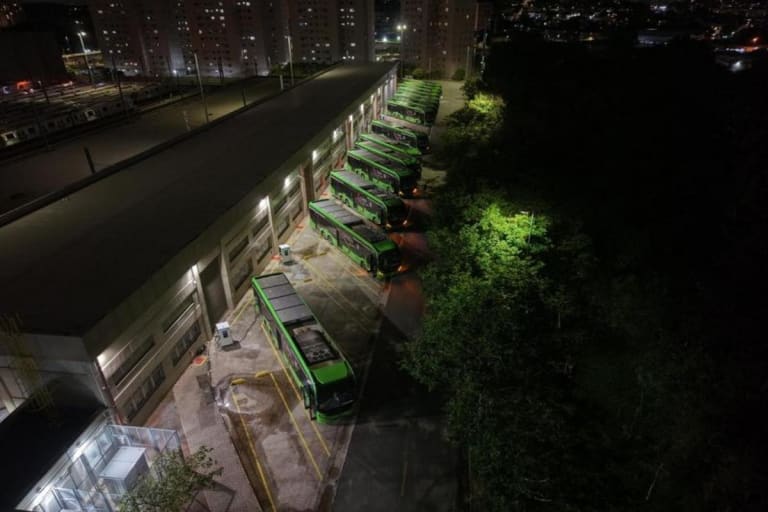
Motiva marks its debut in e-mobility with an R$ 5 million investment in charging infrastructure. The first project focuses on electric buses in São Paulo, utilizing renewable energy to support the decarbonization of transportation.
Motiva, a mobility infrastructure giant in Brazil, has officially formalized its entry into the e-mobility market. In a strategic move to diversify revenue and leverage logistical assets, the company signed its first contract for electric bus charging services with Viação Campo Belo in São Paulo.
This initial step is just the beginning of a long-term strategy aimed at transforming how electric vehicles – from urban buses to ride-hailing fleets and long-haul logistics – are powered. The initiative positions the company as a central player in enabling the energy transition in one of Latin America’s largest urban centers.
Technology and Sustainability in Practice
To achieve this milestone, Motiva invested R$ 5 million in installing state-of-the-art infrastructure at Pátio Guido Caloi, in the southern São Paulo region. The facility features 12 high-power chargers, capable of serving 24 vehicles simultaneously with a full charging cycle of just three hours. The distinguishing factor goes beyond speed: all electricity consumed comes from clean sources, guaranteed by International Renewable Energy Certificates (I-REC).
“Given our extensive expertise in energy management, and considering we are one of the 50 largest energy consumers in Brazil and the second largest in the São Paulo Metropolitan Region, we have the scale, financial capacity, and technical expertise to offer e-mobility solutions for different client profiles. For bus operators, the proposal is to simplify an operation that involves multiple steps and suppliers. We can integrate electrical infrastructure, chargers, energy, and maintenance into a single solution, reducing complexity in fleet transitions,” highlights João Pita, Commercial Director at Motiva.
Solutions for Electrification Bottlenecks
E-mobility faces significant challenges, such as the scarcity of suitable land and limitations in the electrical grids of traditional garages. Motiva leverages its widespread presence and concession management — including subway and train lines 4, 5, 8, and 9 — to offer strategic areas that facilitate the installation of charging stations. This model reduces the financial barrier for transport companies, as Motiva assumes the initial investment and manages the end-to-end operation.
Expansion and the Future of Clean Transportation
The company’s outlook is ambitious. In addition to public transport, Motiva is already articulating plans to serve the e-commerce sector, B2B logistics, and, in the future, long-distance road travel. The company intends to utilize its concessions in crucial corridors, such as the Anhanguera-Bandeirantes System and Presidente Dutra Highway, to create fast-charging corridors.
This expansion aligns with the goals of the Coalition for Transport Decarbonization, which Motiva co-founded. With Brazil’s goal to significantly reduce emissions by 2050, fleet electrification emerges as the primary lever. By delivering clean energy infrastructure, the company not only seeks profitability but also assumes a leading role in building a more sustainable and efficient transport ecosystem for the country.
RELATED NEWS
 Ford invites customers across Brazil to test drive the Maverick Hybrid this Saturday
READ MORE
Ford invites customers across Brazil to test drive the Maverick Hybrid this Saturday
READ MORE
 ABB and Ferrari Unite on Hypersail Project, an Energy-Self-Sufficient Sailboat
READ MORE
ABB and Ferrari Unite on Hypersail Project, an Energy-Self-Sufficient Sailboat
READ MORE
 Marine biodiesel in Rotterdam outperforms conventional fuels following historic price drop and Middle East conflict
READ MORE
Marine biodiesel in Rotterdam outperforms conventional fuels following historic price drop and Middle East conflict
READ MORE