
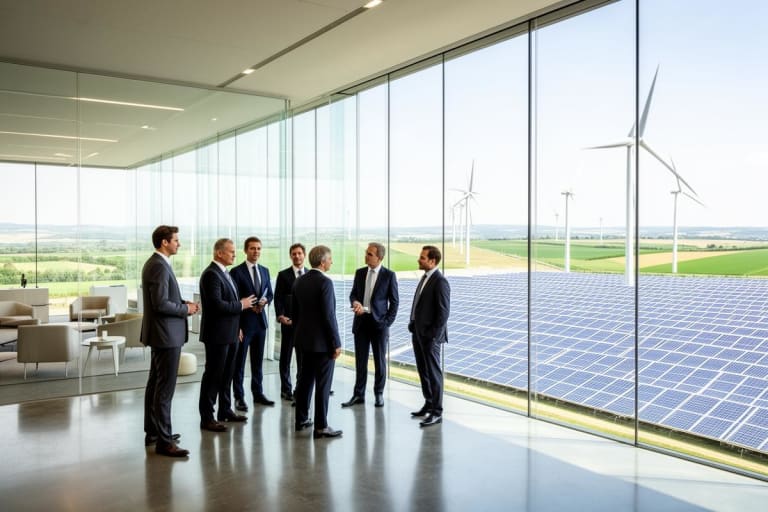
Energy has become a strategic pillar for businesses, moving beyond mere operational costs and requiring sophisticated decision-making in the face of market opening and renewable expansion.
Energy management has shifted from a routine monthly bureaucratic task to a decisive factor for competitiveness and financial planning within organizations. Against the backdrop of the opening of the Free Energy Market and the increasing complexity of the Brazilian power grid, the cost and security of supply now directly impact corporate cash flow and expansion capabilities.
Although a survey by Grant Thornton indicates a slight relief in how companies perceive energy costs as a barrier to growth—dropping from 55% to 52% in 2025—the data actually reflects a shift in corporate mindset. Companies are adopting more mature strategies, utilizing everything from financial hedging mechanisms against price fluctuations to the diversification of energy sources and suppliers.
The New Era of Energy Management
The energy transition, driven by the advancement of solar and wind power, has brought benefits but also flexibility challenges to the national system. With a largely clean energy matrix, Brazil faces supply volatility, which requires companies to move beyond simply chasing the lowest nominal price and start prioritizing predictability and risk management.
Élica Martins, Audit Partner and leader of Energy and Natural Resources at Grant Thornton, stated:
Energy can no longer be treated as just another bill to be managed at the end of the month. In many sectors, it has a direct impact on margins, investment capacity, and competitiveness. This requires a more strategic vision that combines procurement, efficiency, diversification, and risk management.
Strategies Beyond the Bill
Market deregulation expands freedom of choice, but it also transfers greater responsibility to management. Today, the technical analysis of an energy contract involves complex variables such as hourly consumption profiles, contractual terms, supplier stability, and exposure to systemic charges. Tools such as PPAs (Power Purchase Agreements), distributed generation, and storage systems are beginning to integrate into the portfolios of companies seeking operational resilience.
Élica Martins adds:
The opening of the market creates space to seek contracts better suited to each company’s consumption profile and strategy. However, greater freedom also requires greater analytical capability. Energy management should not be limited to the search for the lowest price.
Projections and the Future
The future of corporate energy management points toward a convergence of departments. The topic will be increasingly integrated into finance, operations, and sustainability departments, moving away from being an isolated responsibility. The ability to conduct stress tests, anticipate price scenarios, and adapt to the intermittency of renewable sources will be the key competitive differentiator in the coming years.
The challenge for companies, therefore, is to move away from standardized solutions. In a dynamic, decarbonizing market, resilience will come from the intelligent combination of efficiency, diversified sources, and contracts that offer the necessary flexibility to sustain operations in any market scenario.
RELATED NEWS
 TotalEnergies Plans Up to $17 Billion Annual Investment to Expand Energy Production
READ MORE
TotalEnergies Plans Up to $17 Billion Annual Investment to Expand Energy Production
READ MORE
 Siemens Energy and Data Engenharia consider joint venture to manufacture transformers in Brazil
READ MORE
Siemens Energy and Data Engenharia consider joint venture to manufacture transformers in Brazil
READ MORE
 Single AI data center could inject R$ 1.5 billion into GDP and create 12,000 jobs in Brazil
READ MORE
Single AI data center could inject R$ 1.5 billion into GDP and create 12,000 jobs in Brazil
READ MORE