
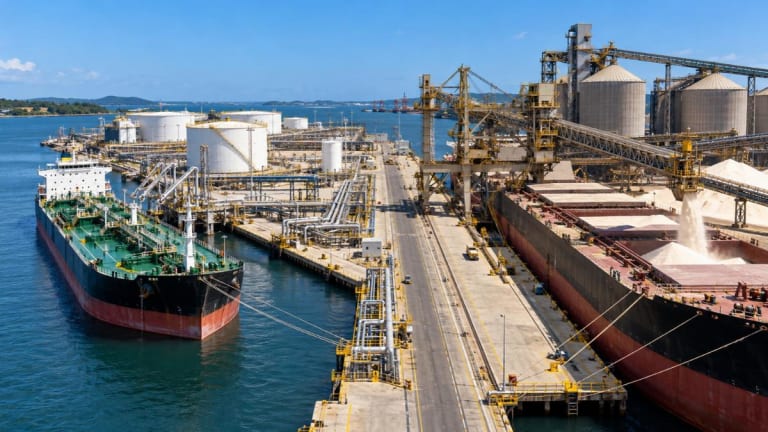
Brazilian ports see a dip in scheduled sugar shipments, but ethanol drives exports with over 100 million liters projected.
Cargo movement at Brazilian ports is showing a mixed outlook this week. While the schedule for sugar shipments has seen a slight decline, the ethanol sector stands out with a significant volume destined for export. The Port of Santos, one of the country’s main logistics hubs, once again leads in cargo handling for both sugar and ethanol.
A recent survey indicates a drop of approximately 3.8% in the volume of sugar scheduled for export compared to the previous week. This decline translates to about 86,000 fewer tons in loading projections. Despite this, the flow of sugar remains substantial, with the Port of Santos concentrating the majority of the activity.
Regarding ethanol, the figures are encouraging for the export sector. More than 103 million liters of the biofuel are scheduled to depart from Brazil. This significant volume reaffirms the country’s position as a primary global supplier of ethanol.
Ethanol: The Star of Port Exports
The export schedule for ethanol leaving Brazilian ports shows a robust volume. Between early and mid-October, approximately 82,919 tons of ethanol were slated for shipment, equivalent to roughly 103 million liters. The concentration of these shipments is, once again, at the Port of Santos, which accounts for a significant portion of this total.
In addition to Santos, other major Brazilian port complexes also appear in the ethanol export schedule. The Port of Rio de Janeiro and the Port of Paranaguá, in Paraná, are reporting significant volumes, demonstrating the sector’s reach and the importance of these terminals in the biofuel logistics chain.
Sugar: A temporary decline, but continued relevance
Despite the 3.8% drop in the weekly schedule, sugar remains a highly relevant commodity in Brazilian exports. The Port of Santos leads in projected volume, followed closely by the Port of Paranaguá. This concentration in the country’s southern and southeastern ports highlights the consolidated infrastructure for distributing the harvest.
The survey details various types of sugar scheduled, with VHP sugar standing out as the largest portion of the projected cargo. Other types, such as crystal and refined sugar, also make up the shipping agenda, showcasing the diversity of national sugar production.
Context and Next Steps
It is important to note that the figures provided refer to the scheduling of loading and unloading, not necessarily goods that have already been shipped. The completion of these operations depends on several factors, such as the finalization of loading and logistical conditions.
The difference in monitoring timeframes between sugar and ethanol—the sugar survey covers a longer window through mid-November, while the ethanol data focuses on a shorter period—is a point to consider when interpreting the data.
While sugar scheduling shows a slight retraction, the strong volume of ethanol projected for export signals a positive scenario for the biofuel sector. Thus, Brazilian port logistics remain a key barometer for the performance of the national agribusiness sector in the international market.
RELATED NEWS
 Gas Auction: Chemical industry sees the Federal Government’s first public sale as an opportunity to boost competitiveness
READ MORE
Gas Auction: Chemical industry sees the Federal Government’s first public sale as an opportunity to boost competitiveness
READ MORE
 Petrobras to Receive $859 Million Following Agreement with Partners in Santos Basin Fields
READ MORE
Petrobras to Receive $859 Million Following Agreement with Partners in Santos Basin Fields
READ MORE
 Brazilian Companies Confirm Commercial Value with Artificial Intelligence
READ MORE
Brazilian Companies Confirm Commercial Value with Artificial Intelligence
READ MORE