
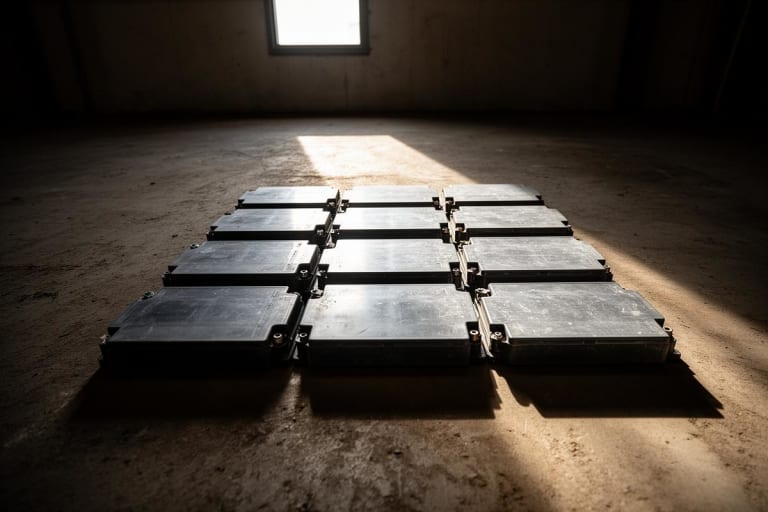
BNDES advances its energy transition strategy by qualifying seven manufacturers for a battery auction, focusing on incentivizing national production of energy storage systems.
The electric power sector in Brazil has taken a strategic step towards modernizing the grid with the qualification process conducted by the National Bank for Economic and Social Development (BNDES).
Seven companies have been validated as eligible suppliers to participate in the anticipated capacity reserve auction, a move that seeks to strengthen the country’s energy security through the use of large-scale storage technologies.
Among the selected names are global giants and national leaders. Brazilian companies WEG, Moura, and You.On, alongside Chinese firms TBEA, Gotion, Trina, and BYD, make up the initial list.
This measure is crucial for meeting the local content requirements established by the government, especially for the tender scheduled for December 2nd.
The Local Content Challenge
Although the first step has been taken, the path requires technical rigor. To date, none of the companies have completed the second stage of the process, which demands formal proof that the storage systems – known by the acronym SAE – fully comply with the nationalization requirements for components.
Qualification through the CFI System acts as a compass for the market, defining which technologies will be recognized as national in Product A of the auction, ensuring that industrial development keeps pace with the evolution of Brazil’s energy matrix.
This control is carried out through the Computerized Supplier Qualification System (CFI), a tool that serves as the reference criterion defined by Normative Ordinance MME No. 136.
Even if companies use external financing, validation by BNDES is the differentiator to attest that the product meets internal manufacturing requirements.
Prospects for the Battery Market
The December auction will be a watershed moment. While the December 2nd tender reserves exclusive space for technologies with national content, the subsequent event on December 4th will operate without this specific restriction.
Winners from the first group will have an extended deadline, until May 2027, to submit final conformity certificates to the bank.
Companies like WEG and Moura have an advantage as they already possess consolidated production infrastructure in the country.
In parallel, integrators like You.On and several international players are seeking to strengthen strategic partnerships with local industries to enable the assembly and development of energy management software and firmware (EMS).
With the advancement of these requirements, the country signals to the global market that it intends not only to import technology but also to develop a robust value chain around storage systems.
This transition is seen as vital for absorbing the intermittency of renewable sources and ensuring the stability of the national electric system in the coming years.