
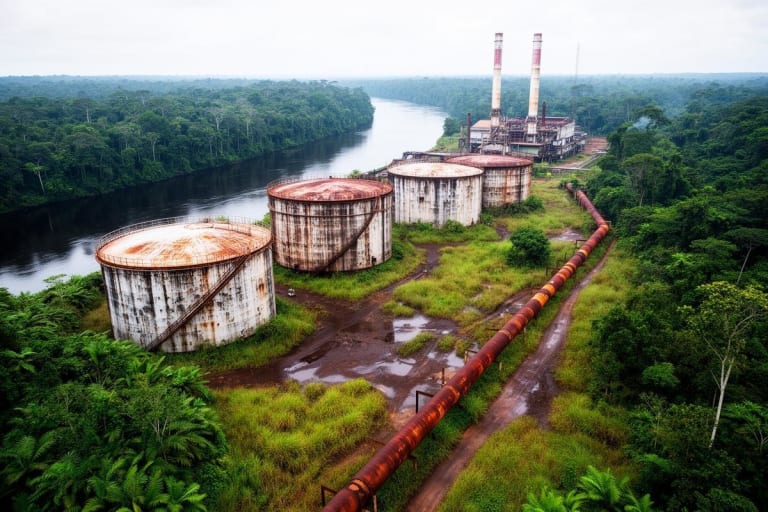
Amazonas to Receive R$308 Million to Shield Energy Supply. Funds from the CCC will be advanced to bolster fuel reserves and mitigate El Niño risks.
The vast and crucial Amazon region faces climate challenges intensified by phenomena such as El Niño and prolonged drought. To ensure energy security and prevent a collapse in energy supply to the most remote communities in Amazonas, the National Electric Energy Agency (Aneel) has approved a strategic emergency measure.
Power generators operating in the state’s isolated systems will receive R$308.4 million from the Fuel Consumption Account (CCC) in advance. This financial provision will enable the formation of strategic fuel reserves for thermoelectric plants, minimizing the impacts of severe river navigation restrictions expected in the coming months.
Essential Reinforcement for Energy Security
The decision by Aneel, made this Tuesday, September 8, addresses requests from Powertech, Oliveira Energia, and Aggreko. The exceptional authorization aims to cover the acquisition of approximately 42.36 million liters of fuel. This proactive action is crucial to overcome the logistical difficulties that historically affect the transport of supplies through the Amazon basin.
The largest portion of the funds, estimated at R$266.2 million, will go to Aggreko, for the purchase of 36.43 million liters. Powertech will receive about R$30.2 million for 4.24 million liters, while Oliveira Energia will allocate R$12 million for an additional stockpile of 1.69 million liters.
Aneel emphasized that, although these costs would be reimbursed under normal conditions, the advance payment is critical to guarantee operational readiness.
A representative from Aneel explained, underscoring the strategy’s importance:
Advancing fuel reserves is a considerably more economical measure than facing the consequences of a possible shortage, which would require high-cost emergency solutions, such as air transport or activation of additional generation.
El Niño Threat and River Logistics
The main concern is the forecast of a drastic reduction in the navigability of Amazonian rivers, vital for fuel transport. In June, Aneel‘s inspection had already mobilized distributors, generators, and authorities to develop contingency plans, aiming to protect the supply to localities dependent on isolated generation systems.
The Madeira River and its connection to the BR-230, as well as the regions of Alto and Médio Solimões, Javari, Juruá, Purus, and Rio Negro, were identified as critical points.
Currently, many thermoelectric plants have 30 to 60 days of fuel autonomy, a period considered insufficient given the projected intensity of El Niño. A 120-day reserve is the ideal scenario.
Powertech, for example, will distribute its extraordinary stockpile among power plants serving Manicoré and Novo Aripuanã, anticipating logistical difficulties even without a complete interruption.
Oliveira Energia focused on Pauini and Santa Isabel do Rio Negro, aiming for autonomy until the end of December and January 2027, respectively.
Aggreko, with the largest demand, will concentrate its volumes across various operations in the Isolated Systems.
Transparency and Next Steps
The release of funds is conditional upon proof of fuel purchase, with invoices to be presented to the Electric Energy Commercialization Chamber (CCEE) by September 18. The advanced amount will be limited to the lesser of the proven amount and the amount calculated according to regulations.
Amazonian generators will fully repay the CCC in five monthly installments, adjusted by the IPCA. This compensation will be processed in the usual reimbursements that companies receive for energy generation costs.
The technical analysis confirms the financial viability of the advance, partly because programs like Luz para Todos and Mais Luz para a Amazônia had lower execution than budgeted.
However, Aneel‘s deliberation did not include additional logistical costs, such as renting extra barges or transshipment expenses.
The agency considers that these expenses would represent a new charge to the CCC and require further in-depth analysis, as well as approval from the Ministry of Mines and Energy (MME) and the National Energy Policy Council (CNPE), to separate extraordinary costs from those already provided for in the contract.
The release of these funds is a crucial step for the energy security of Amazonas, facing the challenges posed by climate events. By allowing the advance of the fuel stockpile for thermoelectric plants, Brazil seeks to mitigate a scenario of shortages in remote areas, where dependence on river transport is undeniable.
This strategic move underscores the importance of resilient energy systems and signals the continuous need to adapt infrastructure to ensure reliable energy generation and, in the long term, more sustainable energy in vulnerable regions.
The next developments of this initiative will be closely monitored, as they represent a concerted effort to protect local populations and the economy from the severe impacts of nature.
RELATED NEWS
 Âmbar Energia invests R$ 60 million in small hydropower plant, tripling generation capacity in Santa Catarina
READ MORE
Âmbar Energia invests R$ 60 million in small hydropower plant, tripling generation capacity in Santa Catarina
READ MORE
 Petrobras cleared to drill three more exploration wells in the Foz do Amazonas basin
READ MORE
Petrobras cleared to drill three more exploration wells in the Foz do Amazonas basin
READ MORE
 BNDES Invests R$ 300 Million in Electrolux’s Energy Efficiency Technologies
READ MORE
BNDES Invests R$ 300 Million in Electrolux’s Energy Efficiency Technologies
READ MORE