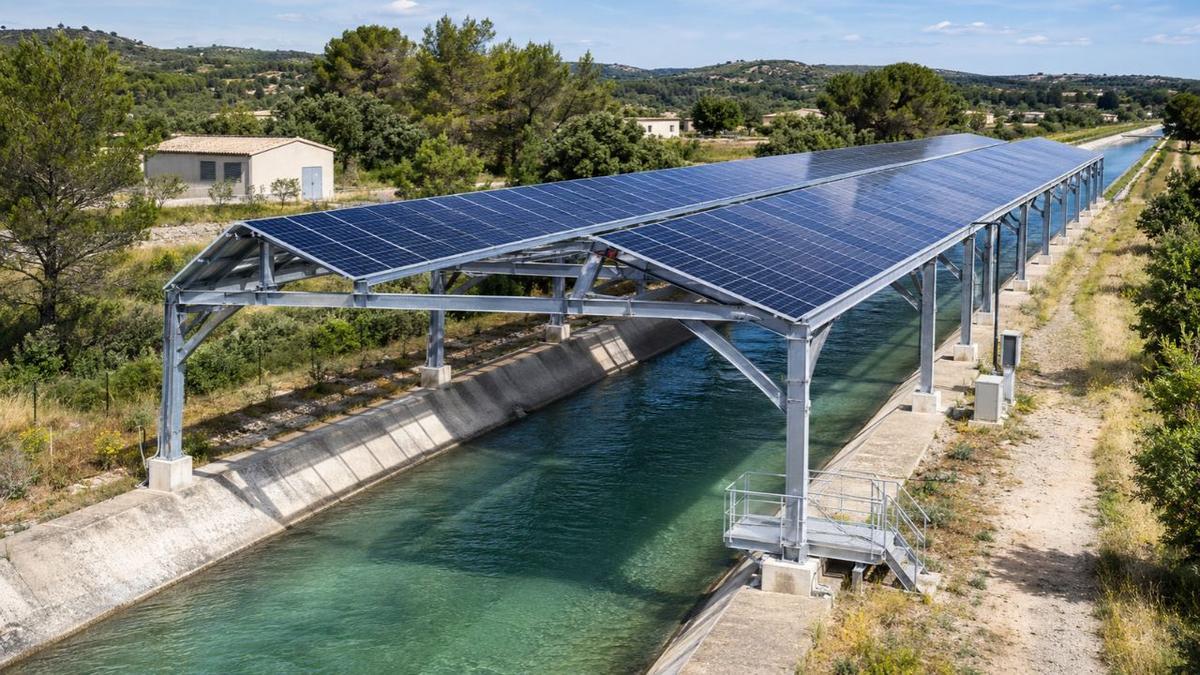
France innovates by opening a solar plant over a water canal in Provence, combining clean energy generation and water resource preservation.
The energy transition takes innovative shape in Europe with the completion of a pioneering project in southern France. A photovoltaic structure was erected directly over a water transport canal, optimizing spatial use without the need to suppress additional land areas. The initiative blends solar energy engineering with natural resource management, emerging as a promising alternative for the sector’s future.
Spanning seventy-one meters, the plant is located in Saint-Maximin-la-Sainte-Baume, in the Provence region. The project is the result of a strategic collaboration between the Société du Canal de Provence (SCP) and the regional government of Provence-Alpes-Côte d’Azur. Official operation began after a series of technical inspections confirmed the feasibility of integrating photovoltaic modules into existing water corridors.
Energy Efficiency and Water Conservation
The system has a nominal capacity of 239 kilowatts-peak, designed to inject about 404 megawatt-hours of electricity annually into the grid. This volume equals the electrical supply needed to power roughly two hundred people or a significant portion of the water utility’s operational demand.
Beyond electricity generation, the shading provided by the panels over the water surface offers substantial environmental benefits. The cover reduces direct solar radiation, mitigating evaporation and hindering unwanted algae proliferation. Project operators plan to monitor these impacts closely to measure the technology’s real ecological gain.
Engineering and Maintenance Challenges
The construction required meticulous planning to avoid disrupting canal flow or hindering cleaning and inspection routines. A robust metal frame was secured along the banks, suspending the equipment safely. Several specialized companies participated in the assembly, covering foundations, electrical infrastructure, earthworks, and local landscaping.
The engineers involved in the project emphasize:
The execution involved multiple partners to ensure that the steel structure and electrical components harmoniously coexist with the hydraulic operation.
This care guarantees that the infrastructure maintains its original function of water transport while also serving as a power generator.
Expansion Outlook on the French Grid
The success of this pilot phase opens the door to an ambitious growth plan for the SCP infrastructure. The channel has dozens of kilometers of uncovered stretches, prompting preliminary studies on the feasibility of scaling the model.
The operator estimates that between five and ten percent of the total length could receive new photovoltaic coverage, adhering to strict technical and regulatory criteria. If all mapped potential is developed, the cumulative capacity could exceed fifty megawatt‑peak, turning the water network into a significant decentralized source of renewable electricity.
The consolidation of this technology will directly depend on data collected in the coming months of operation in Saint‑Maximin‑la‑Sainte‑Baume. Ongoing assessment will calibrate costs, optimize maintenance, and set the pace for future investments aimed at the company’s energy self‑sufficiency.