

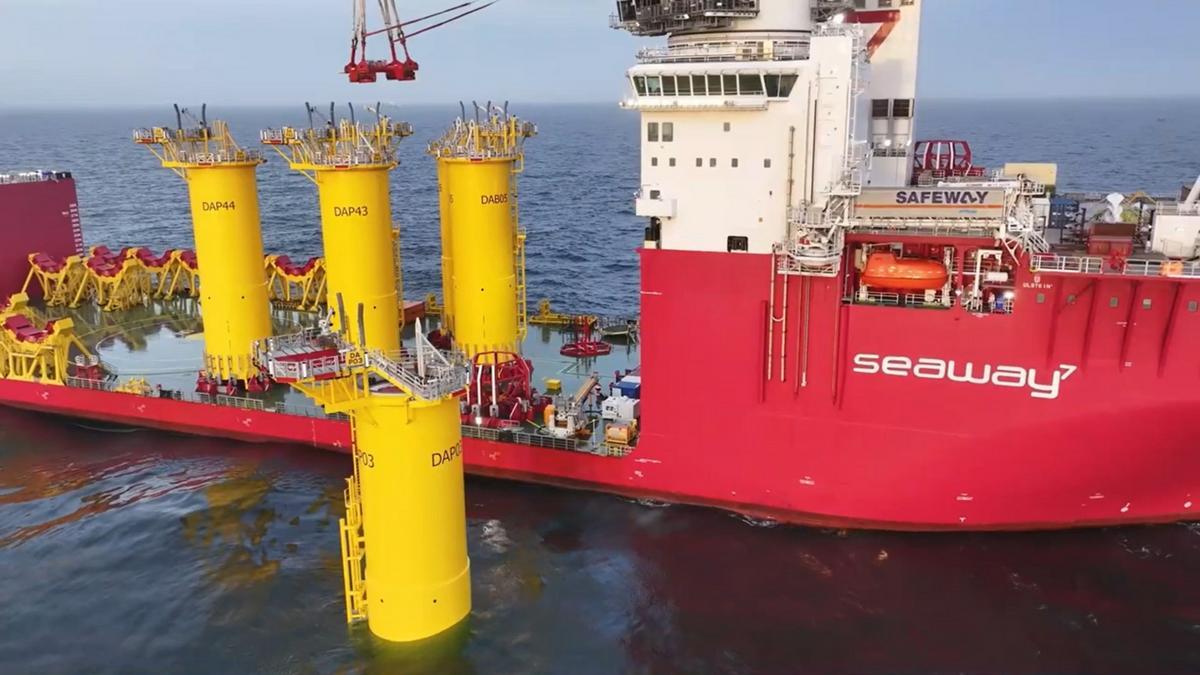
The offshore wind farm Dogger Bank has hired the giant vessel Wind Apex to accelerate the installation of 87 turbines in its third phase in the North Sea.
The global energy transition sector receives a decisive boost in the North Sea, located about 130 kilometers off the northeastern coast of England. The mega-project at Dogger Bank, recognized as the largest offshore wind farm under construction worldwide, announced critical logistical enhancements to solidify its infrastructure.
Project management signed a large contract with the Danish company Cadeler, a specialist in maritime engineering services. The partnership aims to integrate the high‑technology vessel Wind Apex into operations, expanding the capacity for transporting and assembling heavy offshore structures.
Once all operational stages are complete, the plant will boast an installed capacity of 3.6 gigawatts (GW). This production volume will be sufficient to generate clean, renewable energy capable of powering roughly six million British households each year.
Weight reinforcement for maritime engineering
The arrival of the Wind Apex vessel at the work site is scheduled for the third quarter of 2027. The timetable calls for the ship to become operational immediately after delivery by the shipyard responsible for its construction, which should occur by the second quarter of the same year.
Classified as the third unit of Cadeler’s prestigious Class A, the vessel features a versatile design adapted to withstand severe ocean conditions. Its technical specifications allow both the placement of foundation structures and the direct erection of next‑generation turbines.
At the maritime construction site of Dogger Bank C, the new vessel will operate simultaneously and in coordination with the Seaway Ventus ship, which is already active there. The division of tasks between the two sea giants aims to maximize operational efficiency and ensure the achievement of set goals.
The primary focus of the new vessel will be to enable the transport and final assembly of 87 offshore wind turbines. The sheer size of the components demands precise logistics and a highly skilled naval fleet to maintain equipment integrity during ocean handling.
In addition to the specific work focused on the third phase of the complex, the contract allows operational flexibility. The vessel may provide additional support to other stages of the project if there is a need to optimize the overall infrastructure of the venture.
Integrated Management and Technical Rigor
The expansion of the maritime fleet reflects the project executives’ commitment to maintaining a rapid assembly pace without compromising international offshore safety protocols.
Alan Borland, director responsible for the turbine division of the Dogger Bank project, highlighted:
The contract expands the specialized capacity available to complete the project. The priority remains to install the turbines safely and advance the completion of the three phases.
From the naval services provider’s side, operations in British waters will mark the official debut of its newest strategic asset in the global renewable energy market.
Mikkel Gleerup, CEO of Cadeler, confirmed by detailing the contractual scope focused on transporting wind generation equipment:
The campaign will be Wind Apex’s first operation after its delivery.
Three‑Phase Structure and International Consortium
To enable the execution of a project of this magnitude, the complex was divided into three independent development fronts, each designed with 1.2 GW of power: Dogger Bank A, Dogger Bank B and Dogger Bank C.
The wind farm’s ownership is split among a consortium of major international corporations. The British SSE holds a 40% stake and leads the development and construction of all stages.
The Norwegian energy giant Equinor holds another 40% and will assume responsibility for operating and maintaining the complex once the construction phase is complete. The wind‑energy specialist Vårgrønn completes the ownership structure with the remaining 20%.
Investors estimate that the wind complex will have an operational lifespan of at least 35 years. During that period, the plant will be essential for ensuring electrical supply stability and dramatically reducing the United Kingdom’s carbon footprint.
The addition of Wind Apex in 2027 solidifies the schedule that will bring Dogger Bank to its maximum capacity. The initiative sets a new benchmark for the offshore wind industry, demonstrating the technical and economic viability of large clean structures at sea.
With the joint effort of specialized vessels in the North Sea, the expectation is that the final phase of the project will progress quickly. The success of the operation will be a watershed moment in the UK’s strategy to meet its long‑term environmental goals.