
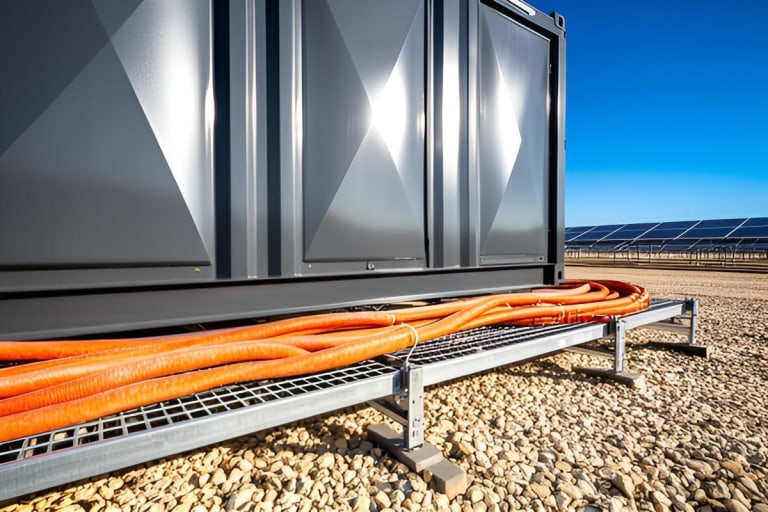
Electric sector entities pressure government to approve Bill 3.716/2026 to change battery cost allocation and ensure the viability of the reserve auction.
The mobilization in the Brazilian electric sector has gained momentum with the union of seven of the country’s leading industry groups. The coalition demands priority from the federal government for the approval of new milestones in financing energy storage technologies.
The initiative seeks to amend the rules of the National Interconnected System (SIN), which currently assign the costs of battery systems contracted for capacity reserve exclusively to generators.
The push was formalized through a joint letter sent to the House of the President, the Ministry of Mines and Energy (MME), and the Ministry of Finance, aiming to secure regulatory stability for upcoming auctions.
Economic impact and market distortions
The organizations ABEEólica, ABIHV, Abrage, Abragel, Absae, Absolar and Apine argue that the current format unduly burdens the generation sector.
According to the bloc, this concentration of charges distorts energy pricing and creates indirect pass‑throughs to consumers, generating asymmetries between the free and regulated markets.
To correct the issue, Bill 3.716/2026, authored by Congressman Arnaldo Jardim, proposes amending Law No. 10.848/2004 to distribute costs proportionally among system beneficiaries.
“Shifting the entire bill to generation agents ignores that the benefits of capacity reserve radiate throughout the entire electric grid.”
Risk of litigation and loss of competitiveness
The group warns that maintaining current rules raises the regulatory risk premium demanded by international financiers, which tends to increase the cost of storage projects.
Beyond higher asset costs, the lack of a balanced cost allocation opens the door to administrative and judicial disputes by penalized agents.
This legal uncertainty scenario could deter investors and compromise the competitiveness of the first SIN auction dedicated solely to battery systems.
The Strategic Importance of Batteries in the National Power Grid
The deployment of large‑scale storage systems is seen as essential for managing the variability of clean sources such as solar and wind.
Technology provides a rapid response ramp to inject power into the grid, ensuring operational stability during peak or stressed periods.
With the legislative text advancing in the Congress, associations are working to raise awareness with the Executive Branch to adjust the financial model before the official notice is released.
Aligning the rules is considered indispensable by industry companies to attract private capital, unlock investments, and usher in a new phase of the country’s energy infrastructure.