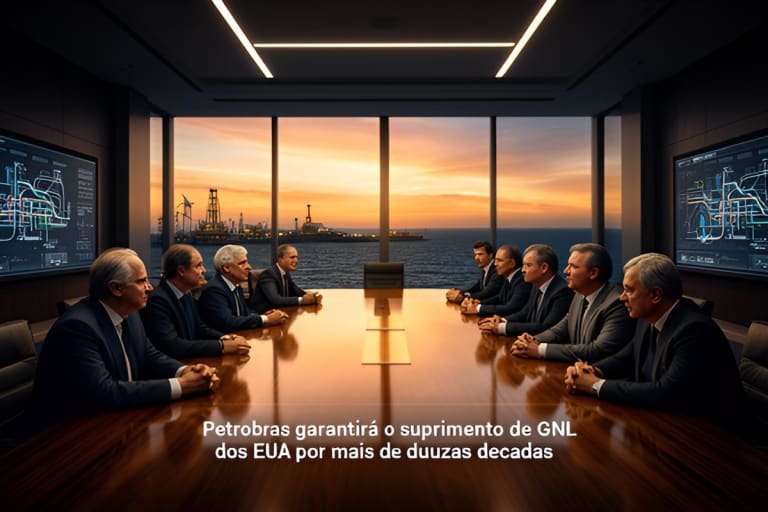
Petrobras intensifies its energy supply strategy by entering into a long-term contract for Liquefied Natural Gas (LNG) imports with American giant Cheniere Marketing.
In a strategic move to shield its national portfolio from international price instability, Petrobras has secured the supply of 0.8 million tonnes per year (mtpa) of LNG. The agreement, with an extended term of 22 years, was finalized with Cheniere Marketing, an absolute leader in U.S. feedstock exports and operator of strategic infrastructure in Louisiana and Texas.
This new partnership reflects the Brazilian state-owned company’s commitment to transitioning from a heavy reliance on the short-term (spot) market to a more predictable and secure supply structure. The measure aims to ensure that the domestic market has stable, long-term energy sources, optimizing the oil company’s operational risk management.
Expansion of the import portfolio
This is the company’s second major move in the sector in less than a month. Recently, Petrobras also sealed a two-decade commitment with Sempra Infrastructure. This previous contract provides for the delivery of equivalent volumes from the second phase of Port Arthur LNG, whose operational start-up is projected for the early part of the next decade.
The strategy reinforces the current management’s stance on seeking resilience for national supply, even within an energy transition scenario where natural gas plays a fundamental role as a transition fuel for the electrical system’s security.
Market and regulatory debates
The company’s contracting policy has been a focal point in discussions about the oil and gas sector in Brazil. The state-owned company’s CEO, Magda Chambriard, has publicly defended the company’s autonomy in conducting its business, countering criticism from the National Agency of Petroleum, Natural Gas and Biofuels (ANP).
The core of the disagreement lies in the so-called gas release program, an ANP initiative aimed at reducing market concentration. In recent statements during the ROG.e event, Chambriard argued that purchasing gas from partners and the investments made by Petrobras are essential to enable complex exploration and production projects, such as the Raia and Sergipe Deepwater (Seap) fields.
The executive stated:
When we buy gas from a partner, we are not acting against the market; we buy to enable business.
The executive highlighted that Petrobras‘s support is vital for new assets to achieve financial viability. The regulatory conflict remains open. While commercial negotiations advance internationally, the domestic scenario awaits the public hearing scheduled for October 21, which is expected to detail the next steps in the regulation of the country’s gas market.