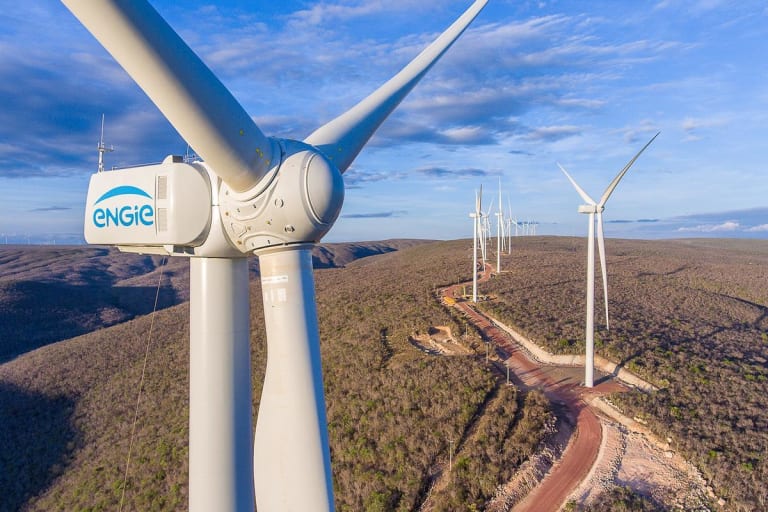
ENGIE Brazil has completed an innovation project that uses algorithms to correct wind turbine misalignment. The initiative boosts operational efficiency and generates energy gains equivalent to installing three new wind turbines.
The pursuit of greater productivity in renewable energy generation drove ENGIE to develop an innovative technological solution for the wind sector. Through a Research, Development, and Innovation (RD&I) project sponsored by Aneel, the company improved the precision of its wind turbines, ensuring that the turbines’ positioning is always optimized in relation to wind direction.
Misalignment of the orientation system — technically known as yaw — is a common challenge that impacts productivity and accelerates mechanical wear. By addressing this issue, the company not only optimizes asset utilization but also strengthens its commitment to the efficiency of the Brazilian energy matrix and long-term sustainability.
Cutting-Edge Technology at the Campo Largo Wind Complex
Executed at the Campo Largo Wind Complex, in Bahia, in partnership with the Federal University of Santa Maria (UFSM), the project utilized LiDAR technology to validate a proprietary algorithm. Unlike methods based solely on simulations, this remote sensing approach, using laser pulses, allowed for real and precise measurements of wind speed and direction in an operational environment.
“The initiative reinforces the strategic role of innovation for the competitiveness of the electricity sector. Innovation is one of the main drivers for increasing the efficiency and sustainability of renewable generation. RD&I projects like this demonstrate how collaboration between companies and universities can transform scientific knowledge into practical solutions, capable of generating value for businesses and for society as a whole,”
— highlights Guilherme Slovinski Ferrari, Director of Renewable Energies and Storage at ENGIE Brazil.
Operational Gains and Energy Efficiency
The algorithm’s application yielded significant results. In specific tests, a turbine that showed a 17-degree deviation saw its performance increase by about 9% after correction. Scaling these adjustments across the entire wind farm projects a 2.3% increase in annual energy production.
“In addition to validating the algorithm developed by ENGIE, we were able to quantify the benefits of correcting misalignments. In one of the evaluated wind turbines, which had a 17-degree deviation, the correction resulted in a gain of approximately 9% in the turbine’s annual generation. The results show how the intelligent use of data can directly contribute to increasing the operational efficiency of assets,”
— explains project manager, Camylla Amorim.
Impact for the Clean Energy Sector
The success of the initiative in Bahia opens doors for replicating the technology in other company ventures and even in other wind farms across the country. With more than 10,000 wind turbines in operation in Brazil, adopting this methodology could represent a significant advance for the productivity of national wind energy.
In addition to increased generation, the solution contributes to the longevity of equipment by reducing mechanical stress, minimizing corrective maintenance costs. The initiative also leaves an academic legacy, fostering master’s research and consolidating ENGIE‘s position as a reference in energy transition and the application of data intelligence in optimizing renewable sources.