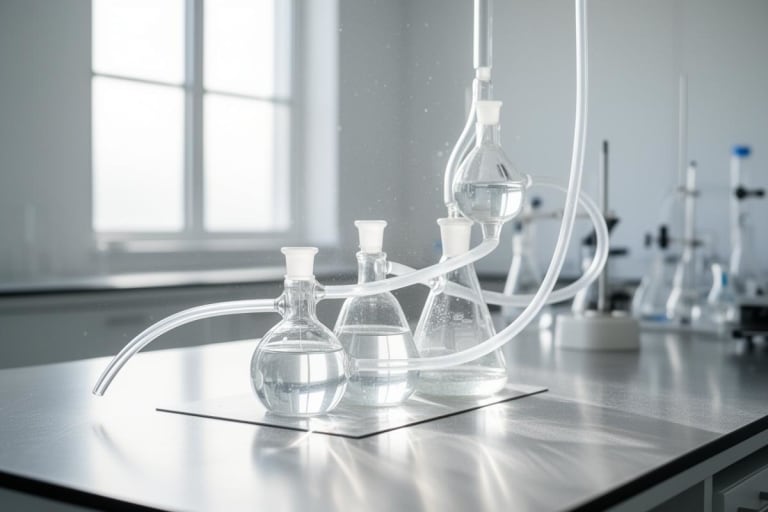
An innovative molecular refining technique developed in China has demonstrated in laboratory tests the ability to reduce energy consumption in the separation of petroleum derivatives by 91%.
Scientists at the Dalian Institute of Chemical Physics in China have taken a promising step toward the decarbonization of one of the world’s most energy-intensive sectors. The new methodology, known as molecular refining, proposes replacing traditional thermal distillation methods with a filtration process that operates at room temperature, eliminating the need for constant heating of the raw material.
The significance of this discovery lies in its efficiency. The conventional process requires crude oil to undergo exhaustive cycles of boiling and condensation to separate its chemical components. The new technology, by contrast, uses high-precision membranes that act as “molecular sieves,” performing the separation of hydrocarbons physically and at a much lower cost.
The role of precision membranes
The effectiveness of this technology depends on the membrane engineering, which is capable of distinguishing between molecules with minimal size differences, on the scale of a hundredth of a nanometer. This refinement allows for the isolation of substances such as linear-chain alkanes—essential for the ethylene industry—from other compounds used in the production of gasoline.
During laboratory tests published in the journal National Science Review, the method achieved a remarkable recovery rate, between 85% and 90%, while processing complex mixtures of 15 substances.
The innovation eliminates the vaporization and condensation stages that consume vast amounts of heat, representing a paradigm shift for the energy sector and plastic manufacturing.
Challenges and environmental impact
Despite the promising results, the project still faces the challenge of transitioning from a laboratory environment to industrial scale. Oil refining is currently one of the largest stationary emitters of carbon dioxide (CO2), contributing approximately 1.3 gigatons per year.
If the molecular refining technology proves scalable, the environmental impact would be significant, surpassing, in terms of emission reductions, what is frequently discussed for sectors like shipping and aviation.
The future of its implementation will depend on further adjustments and investments to validate the technique within the context of a global market that, even while in transition, still relies heavily on fossil fuel derivatives for the production of basic inputs.