A 562% increase in illegal gold mining within Indigenous Territories, combined with the severe effects of El Niño, creates a scenario of “compounded risks” that threatens the survival, health, and culture of the Amazon’s original peoples.
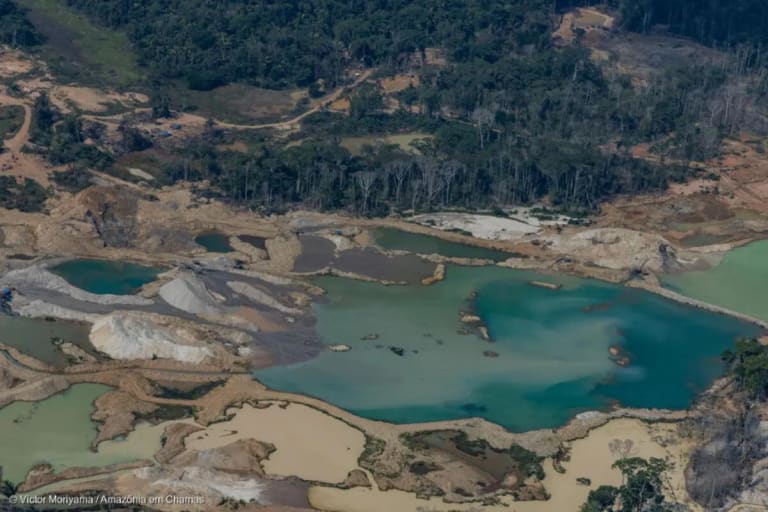
Illegal exploitation of natural resources in the Amazon has reached alarming levels. Recent data reveals that the area occupied by wildcat mining (garimpo) on Indigenous Territories (TIs) grew by 562% between 2016 and 2024. This scenario makes these territories the areas most vulnerable to illicit extractive activities, creating impacts that transcend the physical borders of the mines.
The problem is exacerbated by the climate crisis. Exposure to extreme events, such as intense droughts and heatwaves—often intensified by the El Niño phenomenon—creates an overlapping effect of threats. This dangerous combination compromises not only environmental integrity but also the food security and health of the populations inhabiting the region. To understand the gravity of the situation, you can check the full technical note HERE.
A history of destruction and compounded risks
An analysis published by IPAM (Amazon Environmental Research Institute) points out that, between 1985 and 2024, the mined area in the Legal Amazon increased 20-fold, while within Indigenous lands, this jump was 24-fold. Territories designated for original peoples saw degradation leap from 1,500 to over 36,000 hectares.
The impact, however, is systemic. Even in TIs where there is no direct extraction, mercury contamination via river basins affects 37% of the Amazon’s Indigenous lands. Since mining operations use rivers for logistics and processing, toxic residues travel long distances, affecting fishing, drinking water, and the traditional way of life of local communities.
“Mining does not need to be inside an Indigenous territory to threaten those who live there. Contamination spreads through river basins and adds to the extremes of drought, fires, and floods that already compromise water, food, health, and livelihoods. It is this combination of threats that turns isolated impacts into compounded risks,” says Patrícia Pinho, Deputy Science Director at IPAM.
The climate’s burden on Indigenous vulnerability
The Kayapó, Munduruku, and Yanomami territories account for 89% of the total mined area. The vulnerability of these regions is evidenced by the frequency of climate-related disasters in surrounding municipalities. Between 2000 and 2024, 188 extreme weather events were recorded in these regions. This convergence is what researchers define as “compounded risks.”
“When mining and climate extremes hit the same territories, their impacts are magnified. A drought already compromises mobility, access to water, and food production. If that same water system is also pressured by mining, the combination of these factors influences the communities’ ability to respond. That is why these threats must be addressed in an integrated manner,” emphasizes Ray Pinheiro, an IPAM researcher.
Pathways to protection and sustainability
Addressing this scenario requires more than just land demarcation. Experts advocate for the implementation of Indigenous Adaptation Plans and rigorous control over gold traceability. Furthermore, community-based monitoring of water and health has become a fundamental tool for survival.
Protecting these territories also means preserving knowledge systems and the sustainability of the Amazon itself. The impact of illegal mining and climate change affects everything from forest management to the ability of future generations to remain in their villages. The future of the world’s largest tropical rainforest depends on the integration of effective public policies, environmental oversight, and absolute respect for the sovereignty of Indigenous peoples.