TBG plans a robust $300 million investment to expand its gas network, which is critical for supporting new thermal power plants under the LRCap program. Now, the ANP must expedite its approval.
The Transportadora Brasileira Gasoduto Bolívia-Brasil S/A (TBG) is at a pivotal moment for natural gas supply to the nation’s thermal power sector. The company has secured strategic contracts with the winning power plants from the recent Capacity Reserve Auction (LRCap), which will rely on liquefied natural gas (LNG) delivered by the Terminal Gás Sul (TGS).
This new phase presents a significant challenge to existing infrastructure: the need for substantial financial capital and regulatory agility. To ensure essential supply, TBG has outlined a robust investment plan and is awaiting approval from the National Agency of Petroleum, Natural Gas and Biofuels (ANP).
Strategic Expansion for New Demands
The thermal plants contracted under the LRCap will add a significant demand of 12 million cubic meters of gas per day to TBG‘s network, supplementing the 17 million m³/day currently allocated to the thermal market. To absorb this volume and ensure system reliability, the transporter estimates a $300 million investment in reinforcement and expansion works, with an execution timeline of over three years.
TBG CEO Jorge Hijjar highlighted the urgency of a swift decision by the ANP, emphasizing that the schedule is tight to meet the 2031 operational target established in the auction guidelines.
“If the ANP takes a year, we won’t be able to finish in time to meet the auction requirements,” Hijjar warned, underscoring the critical nature of the timeframe.
Infrastructure Transport Readjustment
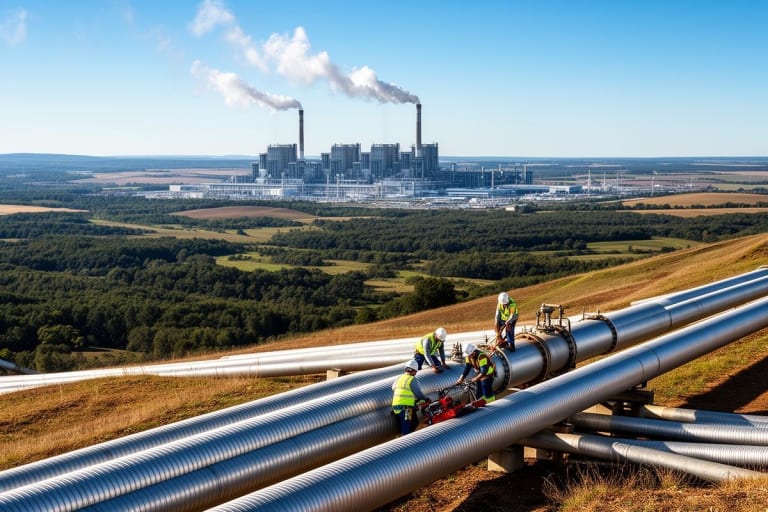
The network reinforcement plans include relocating underutilized compression stations from the Northern section of the pipeline to the Southern region. Furthermore, constructing parallel pipeline segments will be fundamental to optimizing natural gas flow, allowing the supply to reach plants located in São Paulo, where demand is rising. The Northern section currently operates at approximately 12 to 15 million m³ of its 30 million m³ total capacity, offering a strategic solution for asset reallocation.
The Role of Terminal Gás Sul (TGS)
A key component in meeting this demand is the arrival of the TGS Floating Storage and Regasification Unit (FSRU), scheduled for mid-2027. This terminal, originally built by New Fortress Energy (NFE) — now Arxen — and inaugurated in 2024, had its vessel temporarily removed in 2025 due to LRCap regulatory delays. In 2026, its operation was leased to J&F, consolidating TGS as a pillar of LNG supply.
Overview of Natural Gas in Brazil
The expansion landscape for natural gas in Brazil was reinforced by Claudia Sousa, Executive Manager of the Association of Natural Gas Pipeline Transport Companies (ATGás). During a panel at ROG.e, she detailed that of the 18.9 GW of power contracted in the LRCap, 15 GW correspond to natural gas projects, with 7 GW to be connected to the transport network—3 GW in new plants and 4 GW in existing units.
Sousa pointed to new demand prospects, such as Equinor’s Raia Project, with projections of 20 million m³/day starting in 2029, and Petrobras’s Sergipe Águas Profundas (Seap), expected to add another 18 million m³/day by 2031. Additionally, there is a potential for 6.5 million m³/day of biomethane, alongside LNG terminals and the growing demand for decarbonization and data centers. The executive concluded that Brazil is experiencing a scenario of “potential like none seen in recent decades,” with the transport network acting as the “backbone” connecting supply and demand.
Realizing these investments in natural gas infrastructure is fundamental for the country’s energy security and its transition toward a cleaner and more sustainable energy matrix. The agility of ANP’s regulatory processes and the execution of TBG’s projects will be decisive for Brazil to fully leverage its potential in the energy sector.