
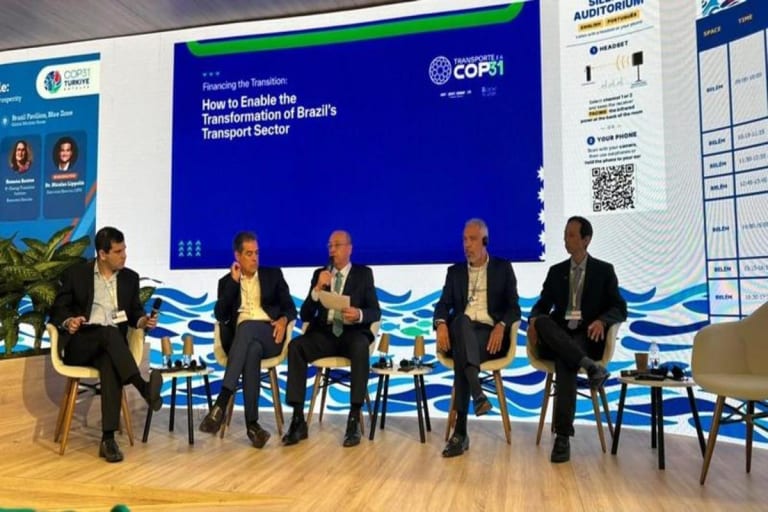
The structuring of projects and the attraction of sustainable investments were the main highlights of Banco da Amazônia‘s participation in COP31, focusing on legal security and green transition.
Banco da Amazônia’s participation in COP31, held in Antalya, Turkey, put the urgency of energy transition and climate financing for the biome at the center of global discussions.
During the event’s fifth day, dedicated to Trade and Finance, the financial institution highlighted the strategic role of sustainable credit in enabling infrastructure and clean energy initiatives on Amazonian soil.
The presence of bank executives reinforced the need to overcome logistical and regulatory barriers. The event served as a showcase to demonstrate how sustainable development in the region depends not only on robust financial resources but also on legal and technical engineering capable of attracting the international capital market to long‑term projects in the Amazônia.
Infrastructure and clean energy challenges
At the Brazil Pavilion, the institution’s president, Luiz Lessa, discussed pathways to enable the transformation of national transport and productive matrix.
The executive identified the main bottlenecks for implementing projects in the northern region, emphasizing the importance of financial instruments that ensure security for investors in renewable energy, railways, and sanitation projects.
According to Luiz Lessa, the technical support offered to foreign investors is essential to adapt large projects to the local socio‑environmental reality, ensuring the viability of initiatives linked to green transition.
Luiz Lessa stated:
The Bank has extensive experience in providing development credits; we manage the Constitutional Fund for Financing the North (FNO) – the cheapest capital available today – and we also co-manage the Amazon Development Fund. But before accessing this capital, investors must understand the challenges of operating in the Amazon, so projects can be tailored to the local reality. The Bank is partnering with the World Bank and building a Public-Private Partnership (PPP) unit specifically to help structure these projects.
The role of blended finance in the green economy
The combination of public and private resources, known as blended finance, has been at the center of discussions promoted by the World Climate Foundation.
The strategy is seen as essential to close the financing gap that affects developing countries and ecologically critical regions, such as the Amazon basin.
For the institution’s CFO and CRO, Fábio Maeda, success in allocating resources depends directly on the ability to combine financial input with specialized technical support for local companies.
Fábio Maeda stated:
Driving sustainable development in the Amazon requires combining financial investment with technical assistance, helping innovation firms turn good solutions into real, structured businesses.
The agenda of debates on sustainable finance continued to mobilize major financial sector entities such as Anbima, CNSeg, and Febraban, underscoring the urgency of turning climate commitments into scalable, high-impact projects for clean energy and conservation.
The Amazon Bank‘s engagement in COP31 demonstrates a new level of resource coordination for the country’s north.
By linking development funds, international partnerships with the World Bank, and structuring new governance models, the institution paves the way for the green economy to move from promise to a compelling reality for the global financial market in the coming years.