
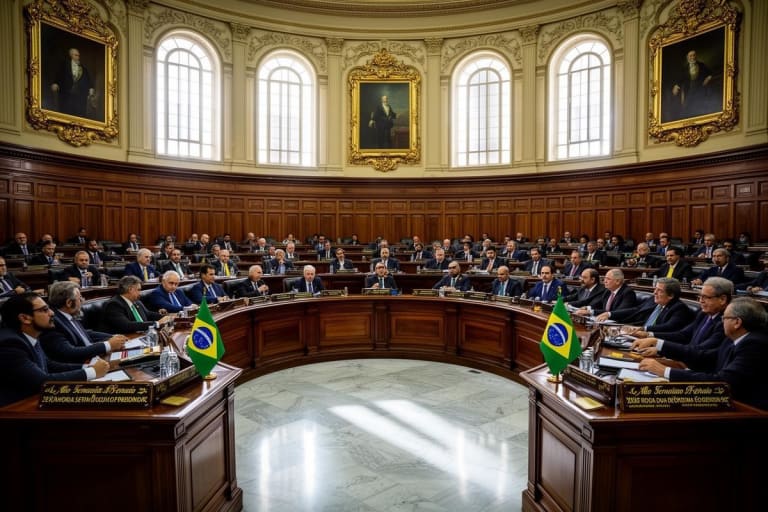
The Federal Senate has approved the nomination of Rodrigo Pacheco as a minister of the TCU (Federal Court of Accounts), a pivotal move for national governance with significant implications for energy regulation and the future of clean energy.
The composition of the Federal Court of Accounts (TCU), an agency of vital importance for auditing public accounts in Brazil, saw a significant development this week. The Federal Senate confirmed the nomination of Senator Rodrigo Pacheco (PSB-MG) to fill one of the coveted seats as a minister on the Court, a vacancy previously held by Bruno Dantas. The decision, made on the floor, marks the first step of a constitutional process that paves the way for his official appointment.
The approval of Pacheco to the TCU is not merely a political-institutional event; it directly impacts strategic sectors of the national economy, particularly the electric power sector. Expectations are high among clean and sustainable energy stakeholders, who are closely monitoring developments within the Court, given its growing role in defining policy and overseeing investments.
Pacheco’s Path to the TCU
Rodrigo Pacheco’s nomination received strong backing from senators, with 63 votes in favor and only 4 against, demonstrating broad support for his appointment. However, for him to take office as a minister, the Senate’s approval is only the first stage. The constitutional process requires the nomination to also pass through the Chamber of Deputies. Following this validation, a presidential decree will be published, formalizing his entry into the Court.
This procedure highlights the importance and rigor involved in filling TCU vacancies reserved for the Legislative Branch, ensuring that nominees have cross-party support among elected representatives.
Impact on the Electric Power Sector and Sustainable Energy
In recent years, the Federal Court of Accounts has exerted increasing influence over the electric power sector. Its work ranges from arbitrating complex regulatory processes to the renegotiation of energy concessions, the oversight of auctions — such as those for capacity reserves — and the monitoring of essential measures for tariff mitigation within the National Interconnected System (SIN). The arrival of a new minister like Pacheco, with his legislative experience, is viewed as a factor that could shape future decisions and interpretations.
The robustness of the TCU’s oversight is a pillar for legal certainty and for attracting investments in clean energy projects.
The TCU‘s role is fundamental to the credibility of the regulatory framework, directly impacting investor confidence in renewable energy ventures and the stability of the Brazilian energy sector.
It is expected that the new minister will contribute to maintaining this vigilant stance, while keeping an eye on the innovations and challenges emerging for the energy transition and the country’s sustainable development.
The approval of Rodrigo Pacheco to the TCU represents more than a change in the composition of an important court. It symbolizes a renewal in the oversight of public policies and projects that will shape the future of Brazilian infrastructure and the economy, with significant weight on the advancement of clean energy and the stability of the electric sector. The next steps in the Chamber of Deputies will be crucial to confirm this nomination so that the country can count on the full operation of the Federal Court of Accounts in the face of the challenges ahead.