
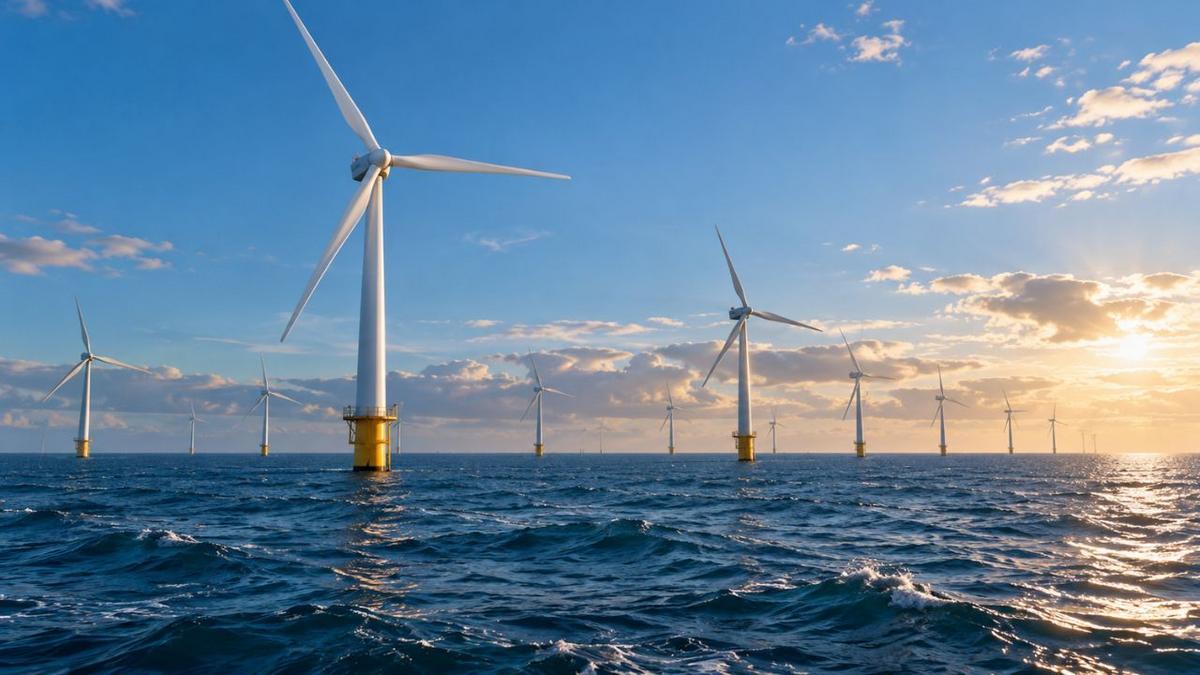
The SENAI-RN has taken a historic step toward the energy transition by outlining its offshore wind pilot plant project, the first in Brazil to receive a preliminary license from Ibama.
The coast of Rio Grande do Norte is moving toward becoming the leading renewable energy laboratory in Latin America.
During the VII Brazilian Congress on Maritime Law, held in Natal, the SENAI-RN highlighted its ambitious initiative aimed at generating electricity from marine winds.
The pioneering proposal, located on the coast of Areia Branca, was dissected by experts as a technological and regulatory milestone for the country.
The significance of the venture extends far beyond simple clean electricity generation.
Developed by the SENAI Institute for Innovation in Renewable Energies, the complex will serve as an advanced hub for Research, Development, and Innovation.
The primary goal is to decipher the behavior of oceanic winds and adapt international technologies to the national geographic reality, paving the way for future commercial offshore installations.
Innovation and Environmental Pioneering
Securing approval from Ibama has placed the Rio Grande do Norte project in a position of national prominence.
It is the first offshore wind pilot plant on Brazilian soil to surpass the preliminary licensing phase, ensuring legal and environmental security for the start of practical research stages.
During its presentation at the event, the institution’s regional director, Rodrigo Mello, emphasized the urgency of creating solutions that respect the unique characteristics of the country’s coastal ecosystem.
The executive noted that the accumulation of technical data will be vital to underpin future regulations and ensure the operational efficiency of forthcoming parks.
The institution’s regional director, Rodrigo Mello, stated:
We need to generate our own technical knowledge so that Brazil’s oceanic potential can translate into real wealth, always respecting the characteristics of our territory and ensuring legal security for investors.
Training and Operational Safety
The transition to the oceanic environment imposes unprecedented logistical challenges, requiring highly specialized labor.
In this regard, the SENAI initiative aims to strongly train professionals capable of handling the installation, maintenance, and operation of massive offshore turbines.
The event also opened space for discussion on maritime sovereignty and protection of sea areas.
Rear Admiral Sérgio Guida, representing the Marinha, spoke about the importance of rigorous strategic planning to avoid conflicts of use in the aquatic space.
For the naval authority, the experience in Areia Branca will serve as a crucial test to align industrial expansion with navigation safety and ecosystem preservation.
Future Perspectives and Legal Framework
The debate on decarbonizing Brazil’s energy mix gained further strength with the analysis of recent regulatory guidelines.
The new Offshore Energy Generation Legal Framework, enacted under Law No. 15,097, was dissected by industry experts, such as Jean Paul Prates, head of Cerne, in panels moderated by lawyer Diogo Pignatari.
Gathering more than a thousand congress members at the Federal Court headquarters, the event reaffirmed the strength of the state of Rio Grande do Norte in the sustainable arena.
With institutional support from FIERN, SINDIPESCA-RN, and SIESAL, the congress solidified Natal as the epicenter of major decisions about the future of oceans and Brazil’s green economy.