

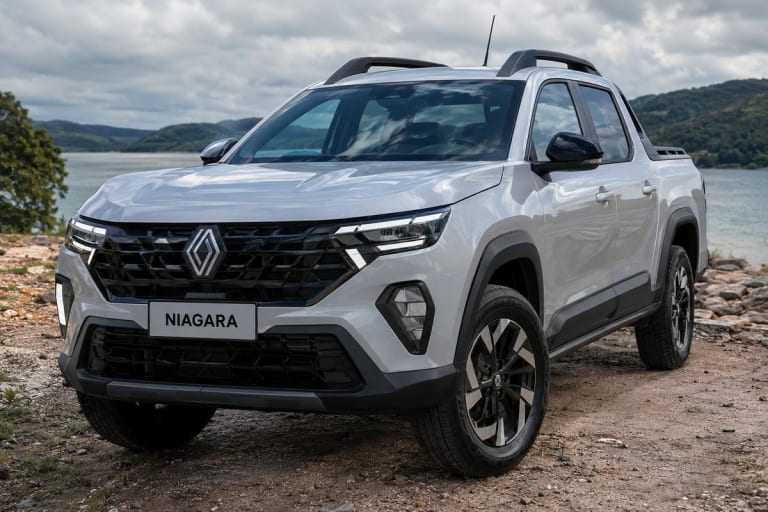
The arrival of the Renault Niagara 2027 promises to intensify the competition among mid-size pickups in Brazil, featuring a turbo engine, advanced technology, and strong pre‑sale demand.
The Brazilian automotive market gains a heavyweight entrant in the utility segment with the official debut of the Renault Niagara 2027 at dealerships nationwide.
Built on the platform of the Boreal SUV, the pickup is set to replace the old Oroch and directly challenge the established leadership of the Fiat Toro.
The initial strategy of the French manufacturer had an immediate impact, selling out the first thousand units available in pre‑sale in less than 24 hours.
Mechanical performance and driving dynamics
Beneath the hood, the pickup houses the TCe 1.3 turbo flex four‑cylinder engine, capable of delivering up to 160 horsepower with ethanol and 156 horsepower when fueled with gasoline.
The maximum torque reaches 27.5 kgfm, providing enough power for quick acceleration and achieving 0 to 100 km/h in 9.9 seconds in the automatic option.
Transmission options include a manual or dual‑clutch automated gearbox, both featuring six speeds tuned for the model.
One of the biggest mechanical highlights is the independent rear multilink suspension, designed to deliver superior stability and dynamic comfort even on uneven surfaces.
Strategic dimensions and payload capacity
Designed for work and urban use, the Renault Niagara measures 4.91 meters in total length with a generous 2.96‑meter wheelbase.
Its spacious bed offers a capacity of up to 938 liters, able to carry a payload of 654 kg in the Evolution version with an automatic gearbox.
The manufacturer has incorporated practical solutions for everyday life, such as a 36‑liter internal storage compartment located behind the rear seats to keep fragile items.
The bed structure also adds essential features, such as cargo attachment points, a 12‑volt outlet, and assisted rear hatch opening.
The ground clearance is 22.3 centimeters on the 4×2 variants, facilitating travel on unpaved roads without compromising the vehicle’s structure.
Technology and Safety Package Onboard
From the automatic Evolution entry configuration, the pickup stands out for its comprehensive driver assistance offerings and modern connectivity.
The model features six front and side airbags, adaptive cruise control (ACC), autonomous emergency braking, and full LED lighting.
Interior comfort includes a 10‑inch multimedia center compatible with Android Auto and Apple CarPlay, digital climate control, and electronic parking brake.
In the top‑tier options, the equipment list expands significantly, adding up to 26 advanced driver‑assist technologies.
Pricing, Models, and Certified Fuel Economy
Prices announced by Renault began at R$ 139,990 for the sold‑out promotional price of the Evolution MT version, whose official list price is R$ 154,990.
The Evolution AT option is listed at R$ 164,990, while the Iconic AT version reaches R$ 194,990 at authorized dealerships.
The top‑tier model, Outsider AT 4×4, will later enter the domestic market with a fixed price of R$ 209,990 for interested buyers.
Data from the Brazilian Vehicle Labeling Program of Inmetro indicate urban fuel consumption of 11.0 km/l with gasoline and 7.5 km/l with ethanol for the automatic transmission.
On highways, the Renault Niagara achieves 12.8 km/l using gasoline and 8.8 km/l when fueled with plant‑based fuel.
Market Outlook and Competition
The Argentine‑made launch refreshes the brand’s lineup and aims to challenge the dominance held by the Fiat Toro over the past decade.
The eight‑year or 160,000‑km extended warranty reflects confidence in the product’s reliability for Brazilian consumers.
The coming months will be decisive in determining whether sales volume will maintain the strong pre‑sale momentum and whether hybrid versions will strengthen the future catalog.