

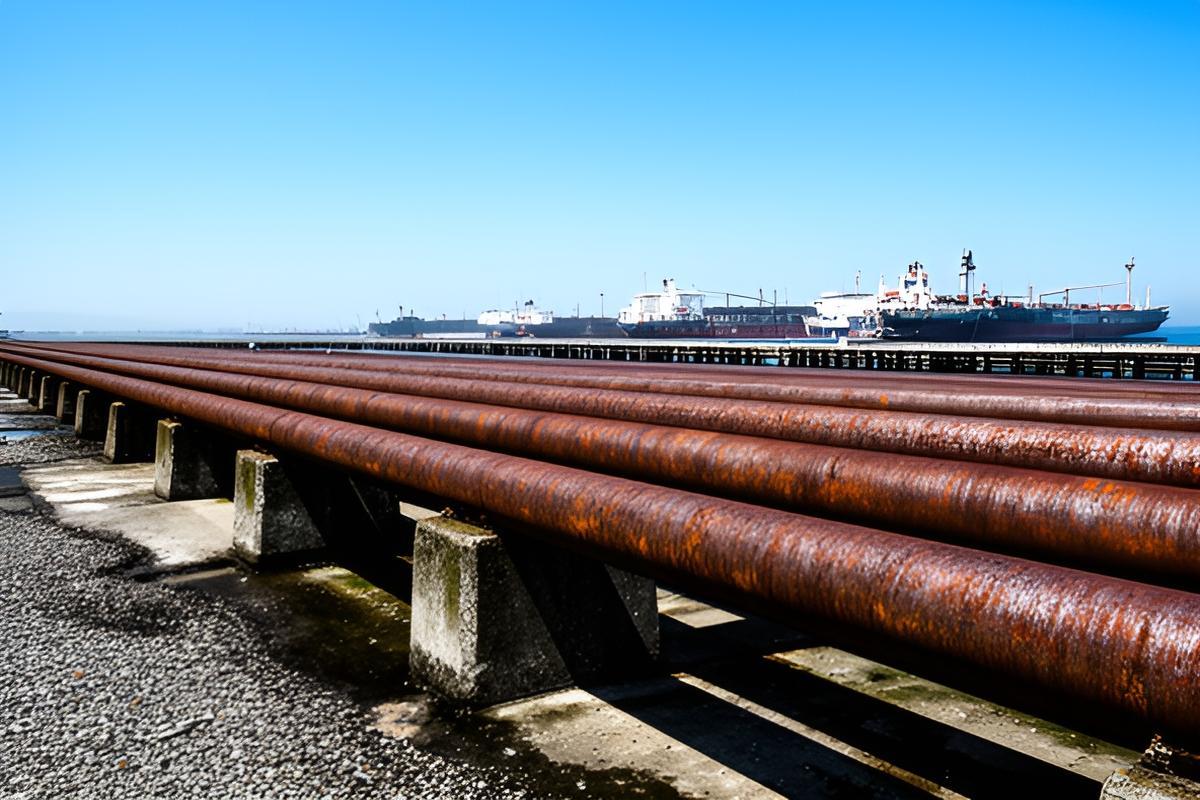
The Açu Port and the German agency GIZ have begun studies to create a pipeline network focused on transporting renewable hydrogen and low‑carbon fuels in Rio de Janeiro.
To accelerate the energy transition and establish itself as a green economy benchmark, the Açu Port sealed a strategic partnership with the German cooperation agency GIZ. The initiative aims to map the economic and operational feasibility of pipelines dedicated to e‑fuels.
The project, called Future Green Fuels Hub, foresees a total budget of 400,000 euros, roughly equivalent to R$ 2.5 million. Analytical activities will be carried out over twelve months with support from international partners.
The proposal comes at a time when the industrial complex in São João da Barra is seeking new investments focused on decarbonization and strategic supply for the external market.
Strategic investments and international cooperation
Partially funded by the H2Uppp program, the survey receives support from the European Union and the German Federal Ministry of Economy and Energy. The other half of the contributions will come in the form of technical know‑how from the participating companies.
In addition to the manager of the Fluminense complex, Prumo Logistics, the study directly involves the Port of Antwerp‑Bruges International, strengthening the logistical bridge between national production and the European consumer market.
Two pipeline infrastructure fronts
The plan covers a detailed assessment of two pipeline extensions to optimize the region’s production flow. The first front includes eight kilometers of network to connect the generation hubs to the Açu Liquids Terminal (TLA), managed by Vast Infrastructure.
The second section envisions about 35 kilometers of connection to local external networks. This route will be crucial for capturing strategic inputs such as biogas and biogenic carbon dioxide, essential for producing synthetic fuels.
The central premise is to build a shared model where multiple producers share the same logistics‑industrial structure, significantly reducing costs and expanding operational efficiency.
Mauro Andrade, Executive Director of Business Development at Prumo, highlighted:
“Logistics is a determining factor for the final cost of hydrogen projects and their low‑carbon derivatives.”
Consolidation of the sustainable hub and global projection
The pipeline analysis adds to the master plan for expanding the port complex, which already has a licensed area of up to 5.5 million square meters dedicated to green ventures. Among the manufacturing priorities are SAF (sustainable aviation fuel), e‑methanol, and green ammonia.
Projects such as HIF Global illustrate the area’s potential, with targets to produce up to 800 000 tonnes of e‑methanol per year. A partnership with Vast Infraestrutura already envisions storage for 40 000 cubic metres of fuels at the terminal.
The new phase strengthens the agreements made to establish a sustainable maritime corridor linking South America to Europe, with operations slated to begin before 2030.
With the structuring of a shared and efficient logistics system, Brazil positions itself as highly competitive in the global race for clean energy matrices and zero‑emission industrial solutions.