
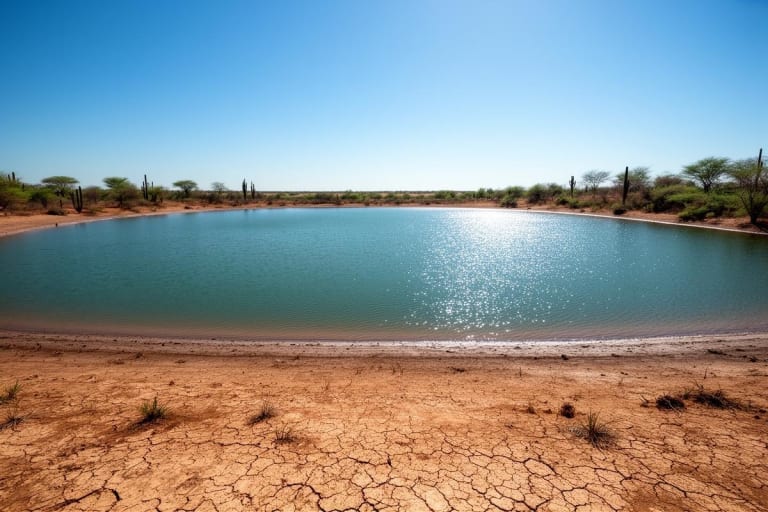
Brazilian reservoir levels show a slight decline across the country. With the Northeast recording 62.6% of its capacity, the electricity sector monitors national water management.
The current scenario of Brazilian reservoirs reveals a widespread downward trend in stored volumes from the north to the south of the country. Recent industry data indicate that the Northeast region, a strategic point for the national energy matrix due to the expansion of renewable energy, showed a reduction of 0.6 percentage points, settling at 62.6% of its total capacity.
This fluctuation in water levels is not isolated. Monitoring of river basins shows that water resource management requires constant attention from responsible agencies to ensure supply security and stability in clean energy generation. Although these variations are gradual, they reflect current climatic behavior and the demand on the interconnected system.
Impact on other Brazilian regions
In addition to the Northeast, other regions also reported decreases in their levels. The North subsystem saw a decline of 0.3 percentage points, while the South followed the same trend with a 0.3 p.p. drop. The Southeast/Central-West region, historically the heart of Brazil’s hydroelectric generation park, recorded the smallest variation among the regions, with a decline of 0.1 percentage points.
Although these numbers point to a decline, industry experts weigh in on the complexity of water management. The diversification of the energy production base, with the accelerated growth of solar and wind energy, has been fundamental in mitigating supply risks, allowing hydroelectric plants to operate more strategically and efficiently.
Continuous monitoring of basins is a pillar for the resilience of the electric system. Balancing renewable sources is the key to facing natural variations in storage in Brazilian reservoirs.
Perspectives for energy sustainability
The future scenario points to the need for energy planning that is increasingly robust and attentive to seasonal changes. With the transition to a low-carbon economy, the strengthening of infrastructure that integrates different generation sources is indispensable. The behavior of reservoirs in regions such as the Northeast—which has become a transition energy hub—will be one of the main indicators for sectoral policy in the coming months.
The focus now turns to the efficiency of available water usage and investment in storage and grid integration technologies. By ensuring that the system operates with data intelligence and diverse sources, Brazil seeks to consolidate its position as a global benchmark in sustainability and energy security, minimizing the impacts of hydrological variations on the daily lives of consumers and industries.