
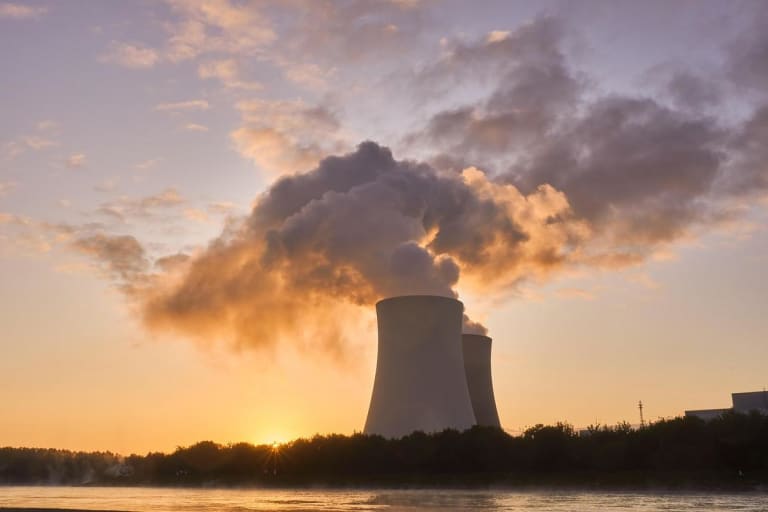
The IAEA projects that nuclear energy will triple by 2060, reaching 1,284 GW, driven by Small Modular Reactors and strong demand in Asia.
The International Atomic Energy Agency (IAEA) has released ambitious projections for the future of global nuclear energy, extending its analysis horizon to 2060. The new report, presented at the agency’s 70th General Conference in Vienna, points to an installed capacity that could more than triple the current level, marking a growing commitment to this energy source.
This is the sixth consecutive time that the IAEA has revised its sector expansion estimates upward, underscoring growing confidence in the role of nuclear generation in the global energy transition. The expectation is that global capacity could reach up to 1,284 GW in the coming decades, a significant leap from the 377.1 GW operational in 2025.
In the high-growth scenario, installed capacity is expected to reach 1,045 GW by 2050—surpassing previous projections—and advance to 1,284 GW by 2060. Even in the low-growth perspective, the global fleet of reactors would still double, reaching 696 GW by 2060, highlighting a robust growth trajectory for nuclear energy.
Energy Demand and Decarbonization: Catalysts for Expansion
The IAEA‘s optimistic revision reflects a confluence of global factors. The accelerated increase in electricity demand, the quest for greater energy security, and the urgency to decarbonize economies are the main drivers behind this projection.
Despite a 1.1% growth in nuclear generation in 2025 (totaling 2,689.1 TWh), the report points to a short-term challenge: total electricity production grew at a faster pace (2.7%), decreasing the relative share of the nuclear source from 8.7% in 2024 to 8.4% in 2025.
For the sector to fulfill its potential, IAEA Director General Rafael Mariano Grossi emphasized the importance of investment:
The IAEA’s projections show the growing role of nuclear energy in meeting the world’s increasing electricity needs. To realize this potential, investment in new nuclear capacity and the life extension of existing reactors will be essential.
Asia at the Forefront and the Impact of Modular Reactors
Central and Eastern Asia emerges as the highest-growth region. The most positive expectations indicate that installed capacity in this area could quadruple, rising from 114 GW in 2025 to an impressive 407 GW by 2060.
Small Modular Reactors (SMRs) are a crucial component in this expansion. In the high-growth scenario, SMRs will contribute 28% of all new nuclear capacity added by 2060. In lower-growth scenarios, their share is still notable, jumping from 5% to 23%. The flexibility and smaller scale of modular reactors make them attractive to diverse regions.
For example, in North America, they could account for up to 60% of new nuclear capacity, while in Latin America and the Caribbean, as well as Southeast Asia, this share is estimated at 40%.
Challenges and Strategies for the Existing Fleet
Despite the optimism, the sector faces the aging of its current fleet. The report reveals that two-thirds of the reactors in operation worldwide are over 30 years old, and nearly half have already exceeded four decades of activity, requiring strategic attention.
In the high-growth scenario, approximately one-third of the capacity existing in 2025 will be decommissioned by 2060. In the low-growth scenario, retirements could reach two-thirds of the fleet. In 2025, seven reactors were shut down (2.8 GW), while three new units began operation (3.0 GW) and 12 reactors commenced construction, totaling 14.3 GW under development.
To preserve capacity and ensure future supply, governments and operators are investing in Long-Term Operation (LTO) and modernization programs. The IAEA emphasizes that the future of nuclear energy will depend on a strategic balance between large conventional plants, the innovation of modular reactors, and the efficient maintenance of existing assets.
The IAEA‘s 2060 projection reinforces the vital role of nuclear energy in supply security and the global sustainability agenda. With the adoption of technologies like SMRs and strong demand in emerging economies, especially in Asia, the source is consolidating itself as an essential pillar in the complex journey of the energy transition, requiring continuous investment and robust policy support.