

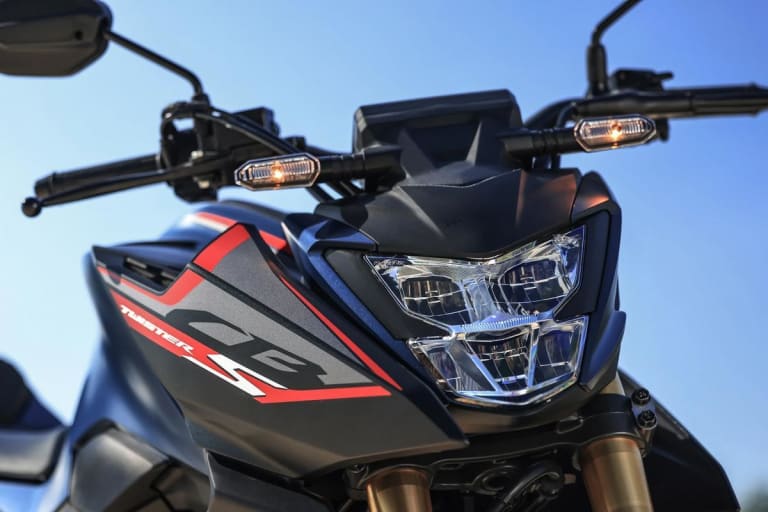
The new Honda CB300F Twister 2027 arrives in the Brazilian market, bringing crucial updates to the inverted suspension, traction control, and ergonomics, raising the safety benchmark for mid‑size naked bikes.
Honda has taken a significant step in evolving its flagship naked motorcycle designed for urban and highway use. The arrival of the Honda CB300F Twister 2027 in the domestic market showcases the Japanese brand’s effort to refine the riding experience, focusing on sensitive areas such as stability, comfort, and electronic safety. Without altering the core mechanical setup, the model aims to differentiate itself from direct competitors and justify its prominent position in an increasingly competitive segment.
Inverted Suspension and Cyclist‑Focused Refinement
The major transformation of the Honda CB300F Twister 2027 occurs at the front. The model now features an inverted fork from the renowned Showa brand, using the SFF‑BP system with 38 mm tubes and a 130 mm travel. This structural change delivers greater rigidity to the front assembly, resulting in more precise cornering responses and increased stability during hard braking in urban traffic.
While retaining the Diamond‑type tubular steel chassis and the traditional rear swingarm, the motorcycle received special attention to ergonomics. The handlebars were completely redesigned and now include supports equipped with cushions. This mechanical solution drastically reduces the transmission of unwanted vibrations to the rider’s hands, ensuring more comfortable rides and less fatigue during daily use. With a wheelbase of 1,390 mm and a seat height of 789 mm, the bike’s agility among traffic remains one of its key strengths.
Engine Retained and Electronics Expanded
Under a 14.1‑liter tank, Honda kept the well‑known 293.5 cc single‑cylinder, OHC, four‑valve, air‑cooled engine. Powered by FlexOne technology, the block delivers 24.7 hp with ethanol and 24.5 hp with gasoline, paired with a six‑speed transmission. The assisted, slipper clutch remains a standout feature, providing smooth throttle engagement and preventing rear‑wheel lockup during aggressive downshifts.
However, the real technological leap of the 2027 line lies in its active safety features. The HSTC (Honda Selectable Torque Control) system has been integrated to manage rear‑wheel traction on low‑adhesion surfaces such as wet asphalt or painted crosswalks. In addition, the brand has permanently dropped the CBS versions, making ABS braking mandatory on both wheels, complemented by the ESS system, which automatically activates the hazard lights during sudden decelerations.
Connectivity, variants, and market competition
The blackout LCD digital dash now uses Optical Bonding technology, eliminating glare under intense sunlight and improving readability. The tech package is rounded out by full LED lighting, a USB‑C port, and a key coded with the HISS security system. The 2027 line is split into two options: the entry‑level ABS version, priced at R$ 26,880, and the Twister S configuration, costing R$ 27,680, which adds visual differentiators such as exclusive graphics, red wheel strips, and a passenger seat cover.
In this context, the Honda CB300F Twister 2027 will have to compete with heavy‑weight rivals. While the Yamaha Fazer FZ25 Connected focuses on mechanical simplicity, the Indian Bajaj Dominar 250 emerges as an aggressive threat, offering a 27‑hp liquid‑cooled engine, inverted suspension, and traction control at a lower price, though it is heavier. Honda’s extensive dealer network and mechanical reliability remain the brand’s primary shields against the advance of foreign competitors.
The evolution introduced by Honda in the new Twister demonstrates that the manufacturer has honed dynamic performance and protected riders with cutting‑edge electronics, even without increasing engine power. The coming months will reveal whether Brazilian consumers are willing to pay the price for a motorcycle that has focused its biggest advances on safety and riding experience.