
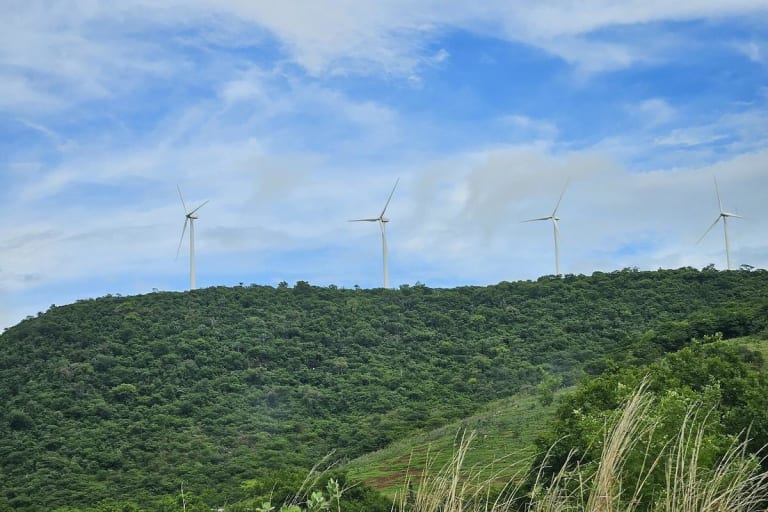
The industrial hub of Camaçari, in Bahia, has regained momentum under the leadership of the Asian giant Goldwind, which took over the former GE plant and now leads domestic wind turbine manufacturing amid a sector contraction.
The reconfiguration of the clean energy market in the country has entered a new chapter with Asian companies taking the spotlight.
The manufacturing complex in Camaçari, previously run by traditional Western brands, has become the epicenter of Goldwind Brazil‘s wind turbine production.
While global competitors chose to shut down their lines amid declining domestic demand, the corporation planted its flag in Brazil and secured a substantial share of the current supply chain.
The advance comes at a time of transition and structural challenges for the renewable generation sector.
Recent data show a sharp slowdown in the installation of new onshore parks in Brazil, a direct reflection of operational bottlenecks that affect company profitability and the attraction of new financial investments.
However, the long‑term strategy adopted by the Chinese‑origin brands has ensured the continuity of industrial operations in the Northeast region.
Robust contracts underpin the assembly line
The assurance of operation at the Bahia unit in the coming months is backed by large‑scale partnerships.
The main agreement was signed with Casa dos Ventos, covering hundreds of megawatts of equipment, and is considered one of the largest deals ever formalized for the national wind industry.
These orders are complemented by requests from EDF, consolidating a volume of orders that exceeds the total of new installations recorded in the country during the current season.
To mitigate the impacts of the shortage of new tenders in the regulated and free markets, the manufacturer adopted a diversified business model.
The company now structures energy parks from the initial phase, delivering ready projects to interested investors, which reduces operational risks and encourages new acquisitions of domestically manufactured wind turbines.
“Today we have more than 50% of the current wind turbine market, of what is being manufactured at the moment. We have close to 50%, 55%.”
Export Plans and the Battery Challenge
The strategic planning of Goldwind Brazil goes far beyond meeting domestic demand.
The company aims to transform the Bahia manufacturing plant into a strategic export hub targeting the American market, covering everything from the north to the southern tip of the continent.
In addition, the brand is closely monitoring the battery energy storage systems sector, known by the acronym BESS, positioning itself ahead of the government auctions scheduled for December.
Goldwind’s moves reflect a broader trend of Asian manufacturers consolidating both globally and locally.
Competitors such as Envision and Ming Yang also have a strong presence in the Brazilian market, competing with European remnants like the Danish Vestas and Nordex Acciona, as well as the domestic WEG.
The competitive edge of these new entrants lies in the high production scale of their home countries and aggressive pricing.
The immediate future of Brazil’s wind sector remains tied to resolving forced generation curtailments, a phenomenon that has caused billions in losses for producers.
While the public sector and entities such as ABEEólica seek definitive solutions to ensure business predictability, the Bahia industrial park continues to operate at a rapid pace, setting the rhythm for South America’s energy transition.