
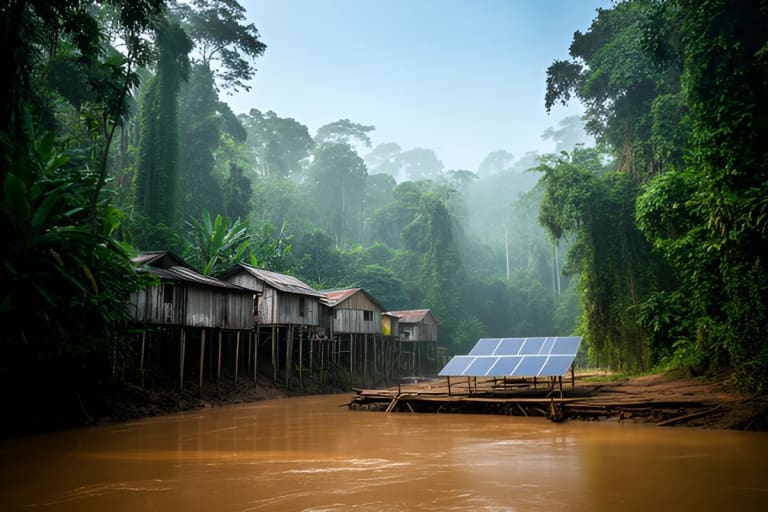
The Forest Energy project, presented by ANEEL at COP31, aims to bring electricity to isolated Amazonian communities, focusing on sustainable maintenance and lifecycle management of equipment.
The arrival of electric power in remote regions of the Amazon represents a challenge that goes far beyond simply installing photovoltaic panels. During COP31, the National Electricity Agency (ANEEL) introduced the Forest Energy program, an initiative that proposes a paradigm shift: prioritizing continuous technical support and durability of solutions rather than focusing solely on the initial construction.
The project serves as a regulatory laboratory to understand how to keep systems operational in areas where logistics are complex and isolation is the norm. The proposal acknowledges that a damaged inverter or a faulty battery can render an entire system useless if there is no clear repair plan, spare parts replacement, and pre-defined operational financing.
A management model focused on longevity
The initiative, in partnership with the Institute of Energy and Environment (IEMA) and the IBRD, places system sustainability at the core of its strategy. ANEEL emphasizes that energy contracts for the region cannot be limited to physical installation; they must include, from the initial budget, corrective maintenance costs and transportation logistics, which in many areas rely exclusively on river travel.
“Support, operation, and maintenance must be evaluated from the outset, because a contract that covers only the initial work can result in months of interruption after the first technical fault.”
To reduce external dependence and ensure a rapid response to potential failures, the program studies the training of community energy agents in partnership with Senai of Rio Grande do Norte. The goal is for residents themselves to identify risks and call for specialized support, without placing the entire technical responsibility solely on the local population.
Reverse Logistics and Socioeconomic Impact
Another critical point discussed in the project is the final disposition of components. Batteries and photovoltaic panels that reach the end of their useful life cannot be discarded in the forest or near water sources. Energias da Floresta seeks to establish a reverse‑logistics route that is financially viable, ensuring that the environmental impact of electrification is minimized.
Beyond infrastructure, the initiative’s success will be measured by its ability to meet real demands. The planning covers everything from supporting productive activities and connectivity in schools to the feasibility of refrigeration systems and electric river mobility. ANEEL emphasizes that community participation, through the right to free and informed consultation, is a fundamental pillar to ensure that the delivered energy truly aligns with each territory’s priorities.
The future of energy solutions in the region will depend on consolidating data collected from these pilots, such as actual operating hours and average repair time. In the long term, the goal is to turn the technological promise into a reliable service capable of replacing diesel and promoting development without sacrificing the operational resilience needed to survive the geographic complexity of the Amazônia.