

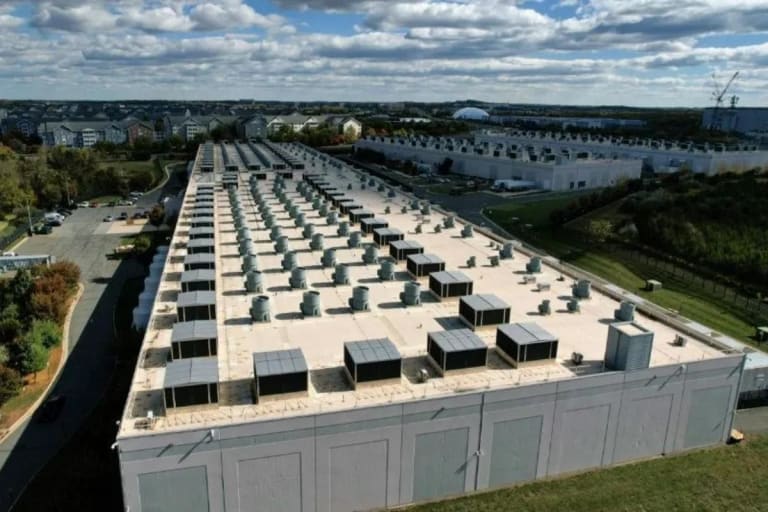
Data center expansion demands urgent reinforcement of Brazil’s power grid to avoid energy bottlenecks.
The growing adoption of artificial intelligence and the resulting expansion of data centers in Brazil pose a significant challenge to the electric sector’s infrastructure.
The energy demand of these facilities, essential for data processing and storage, has been scaling exponentially, requiring robust investments in modernization to ensure supply stability and security.
The Decennial Energy Expansion Plan (PDE) 2036, a comprehensive study conducted by the Energy Research Company (EPE), projects a tenfold increase in electricity consumption by data centers over the next decade.
The estimate is that this consumption will jump from 3 terawatt-hours (TWh) in 2026 to an impressive 30 TWh in 2036.
This scenario is not only about expanding energy supply but also about ensuring quality and continuity of service, a critical factor for data centers that operate under high loads and depend on uninterrupted power flow.
Challenges and Solutions on the Horizon
The need to meet the growing demand of data centers has been integrated into Brazil’s energy planning since 2023.
President of the EPE, Thiago Prado, told CNN that several transmission lots aimed at connecting these facilities, especially in the state of São Paulo, have already been tendered.
Additionally, studies are underway to enable the connection of data center and green hydrogen projects in the Northeast region, with a demand projection that could reach 4 gigawatts.
Beyond building new transmission lines, optimizing existing infrastructure emerges as a fundamental pillar.
One highlighted technology is DLR (Dynamic Line Rating), an innovative system that uses sensors on transmission lines to monitor cable temperature.
This real‑time monitoring capability allows identification of moments when a larger volume of energy can be safely transmitted, expanding the capacity to connect new loads without the immediate need for new construction.
Automation and Monitoring as Allies
Automation plays an increasingly crucial role in this scenario.
Constant monitoring of demand, incorporated into quarterly reviews and the PDE studies, allows for the anticipation of overloads and the maintenance of the electric system’s stability.
This agility is essential to accommodate the entry of large projects such as data centers, which require a stable and predictable energy supply.
Consultancy JLL notes that Brazil has the potential to double its data center market capacity by 2030, with a significant portion of that new capacity already pre‑contracted.
This signals strong market interest, but also anticipatory pressure on the grid.
Tito Costa, CRO of Tecto Data Centers, a platform controlled by BTG Pactual, projects that the country’s capacity could double by the end of 2027 and quadruple in the next five years.
The company, which already operates seven data centers and has two more under construction, including a 200 MW project in Santana de Parnaíba, foresees an investment of US$ 2 billion between 2026 and 2028 to accelerate its expansion in Latin America.
Connection Quality and Investment Attraction
Vinicius Dias, CEO of Grupo Setta, emphasizes that the ability to deliver power with quality at the connection point will be a decisive factor in attracting and retaining investment in the sector.
He stresses that automation and network intelligence can enable existing infrastructure to meet a larger share of projected growth, preventing the country from losing opportunities to other markets.
The speed of expanding connection capacity, without relying solely on lengthy construction cycles for new transmission lines, is seen as a strategic competitive advantage for Brazil.