
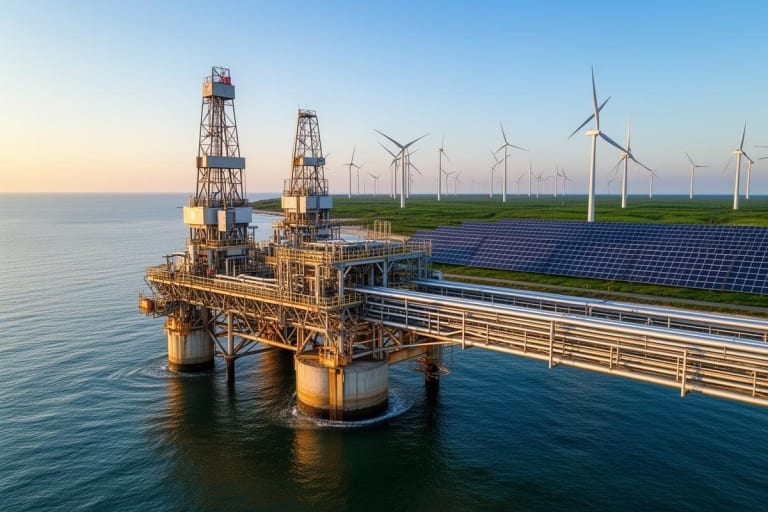
The global energy landscape is undergoing a paradigm shift, where climate urgency and national sovereignty are merging to redraw the map of supply sources and energy security.
The 81st UN General Assembly in New York and the ROG.e trade fair in Rio de Janeiro revealed this week that the energy debate is no longer exclusive to environmental forums. Today, the transition to clean sources is treated as a national security imperative, driven by conflict volatility and the reorganization of global supply chains.
While world leaders discuss the impacts of Artificial Intelligence on electricity demand, the oil and gas market advocates for a gradual transition. The core message is clear: depending excessively on external sources is no longer just an environmental dilemma; it has become an unsustainable economic and strategic risk.
Sovereignty and Strategic Resources
President Lula highlighted at the UN that Brazil holds a privileged position in the new global economy. By addressing the potential of critical minerals and rare earths, the Brazilian government signaled that the exploration of these inputs strictly requires technology transfer and local value addition.
At the same time, the country reaffirmed the continuation of oil exploration, including in the coveted Equatorial Margin. The strategy is to maintain fossil fuel production to ensure stability while accelerating the decarbonization schedule, seeking a complex balance between current revenues and future commitments.
Brazil will need all energy sources developed in a responsible and predictable manner to ensure that energy security and the transition go hand in hand during this period of uncertainty.
Challenges of Self-Sufficiency and Brazil’s Role
Concerns over external dependence have become a recurring theme. The possibility of fuel export restrictions by trading partners, such as the United States, has brought to light Brazil’s vulnerability in refining. Petrobras, under the management of Magda Chambriard, has reinforced the need for greater self-sufficiency in petroleum product processing.
On the renewables front, the biofuels industry is gaining momentum. Projects such as the potential increase of the biodiesel blend to the B17 standard by 2027 and incentives for direct sales articulated by the Parliamentary Front for Biodiesel are viewed as pillars to reduce Brazil’s exposure to international price shocks.
The energy transition is therefore not a linear path. Countries like Germany have already established strict targets to phase out fossil fuels by 2045, focusing on green hydrogen and electrification.
For Brazil, the challenge lies in protecting critical infrastructure and integrating new sources without sacrificing competitiveness. The cost of energy now factors in the variable of geopolitical security, transforming long-term planning into a cornerstone for sector stability.