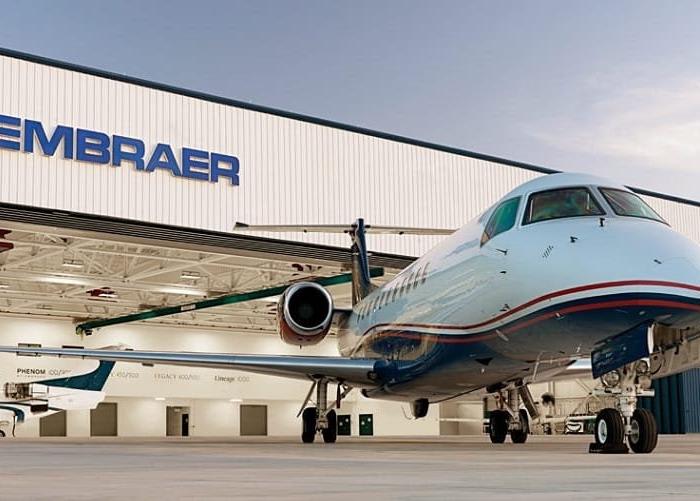
Brazilian manufacturer Embraer reaffirms its global leadership in commercial aviation, maintaining a strategic competitive edge with its E-Jet family of aircraft, even in the face of offensives from giants like Airbus.
Embraer has demonstrated resilience and technical innovation in an increasingly competitive aviation market. While Airbus seeks to scale up aircraft production and delivery, the Brazilian company maintains its leadership position, achieved over two decades, solidifying the E-Jet family as the benchmark for routes requiring more versatility than common regional jets but less capacity than narrow-body models.
The competitive landscape has significantly shifted with the emergence of Bombardier‘s CSeries project, which, after being acquired by Airbus and rebranded as the A220, began directly vying for airline preference. However, Embraer‘s strength lies in the operational maturity of its products, offering a robustness and customer support ecosystem that new competitors find difficult to replicate in the short term.
Strategic Advantages and Portfolio Expansion
One of the pillars supporting the brand in the North American market are the so-called scope clauses. These regulations limit the size of aircraft operated by regional airlines in partnership with major carriers, directly benefiting the efficiency of the E-Jet family models.
“With over twenty years of history, the expertise accumulated by Embraer in operating these models creates a barrier of trust for air operators, consolidating the manufacturer as a safe and high-performance choice against next-generation alternatives”.
Despite the high visibility of the A220 in new orders, Embraer‘s global fleet remains superior in volume. In addition to the classic models—such as the E170, E175, E190, and E195—the new generation E2 has been a sales success, sought after by companies looking for optimization on routes that cannot accommodate larger, heavier jets.
Embraer’s Future
Recent success is not an isolated event. Currently, Embraer holds a solid commercial order backlog, estimated at US$ 15.1 billion, driven by a diversified portfolio that extends beyond commercial aviation. The expansion of regional maintenance infrastructure across various continents reinforces the company’s commitment to service continuity.
With a growing demand for more efficient and sustainable solutions, the Brazilian manufacturer appears well-positioned to maintain its growth trajectory. By offering a combination of route flexibility and established support, Embraer has proven that its market value is sustained not only by technology but also by its ability to meet the precise operational needs of its global customers.