
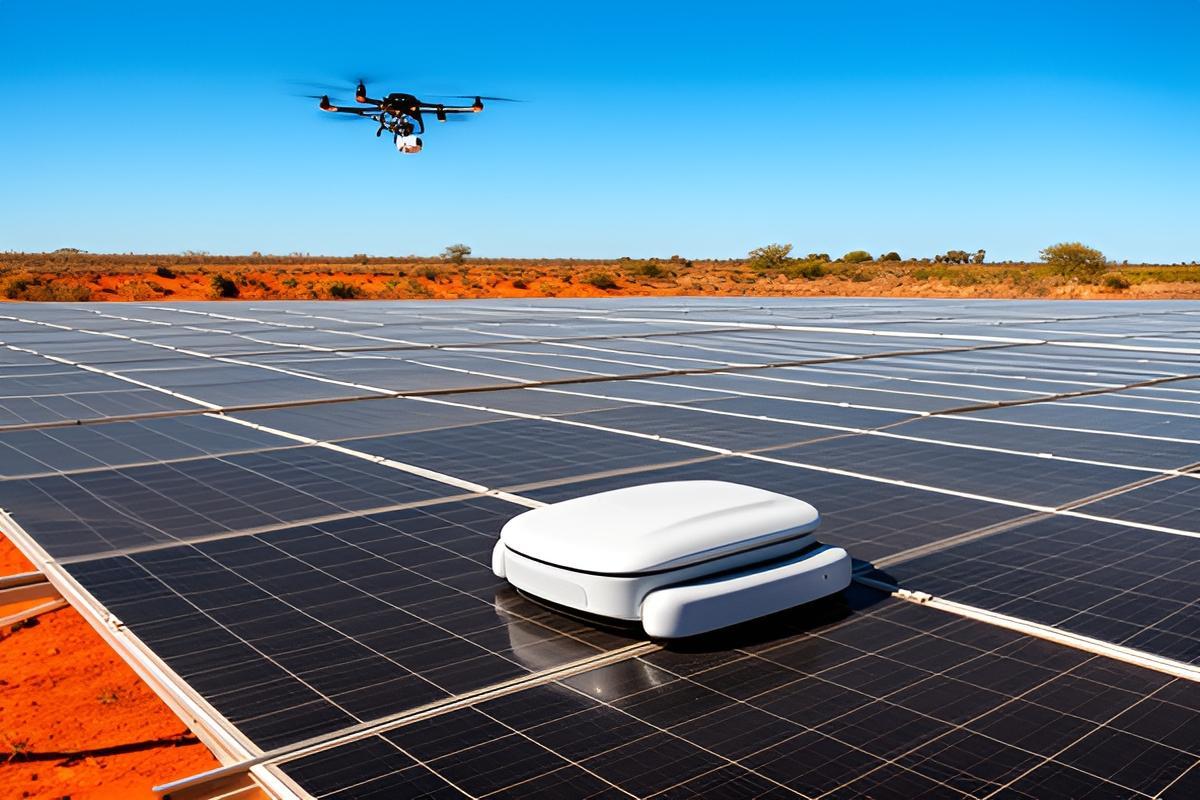
Elera Renewable upgrades the operation of its solar complex in Janaúba, in northern Minas Gerais, integrating autonomous drones and cleaning robots to optimize maintenance and save resources.
The massive Janaúba Solar Complex, with an impressive 1.6 GWp of installed capacity, has become a technology innovation laboratory in Brazil’s renewable energy sector.
With 2.9 million modules spread across 3,800 hectares, manually managing an asset of this magnitude would be infeasible, prompting Elera Renewable to adopt an operational model based on advanced automation and data analytics to ensure maximum performance.
The company’s strategy for northern Minas Gerais focuses on two main pillars: automated thermographic inspection via drones and dry mechanical cleaning.
These solutions not only raise plant efficiency, enabling early detection of electrical anomalies, but also reinforce the company’s commitment to sustainability by avoiding large volumes of water in a dry climate region.
Automation as an Ally in Predictive Maintenance
To monitor millions of components, Elera uses autonomous stations that coordinate regular drone flights equipped with high‑definition thermal sensors.
This technology allows continuous mapping of the panels, quickly identifying hotspots and potential structural failures that, if not detected early, could compromise entire energy generation chains.
The shift from reactive to predictive maintenance allows field teams to be dispatched only when and where strictly necessary.
Guilherme Mendonça, Operations Director of Elera Renewable, stated:
“Operating a plant of this scale is a challenge that combines size, complexity, and the need for rapid decisions to maintain safety and energy generation at maximum performance levels. Monitoring millions of modules spread across thousands of hectares requires solutions that can enhance inspection efficiency and direct maintenance teams.”
Water Efficiency and Sustainability
Another bottleneck overcome by innovation was the impact of soiling—the accumulation of dust and grime that blocks solar radiation.
In a scenario where traditional manual cleaning would have required prohibitive volumes of water, the company chose dry-cleaning robots.
Only in 2025, this technology prevented the use of 540,000 liters of water, preserving the precious resource for the local community.
Beyond the water savings and technical optimization, the company is also focused on the life‑cycle management of its assets.
With the responsible disposal of 16 tons of recycled modules in 2025, Elera demonstrates that the longevity of a large‑scale solar project requires an integrated vision that spans from energy generation to proper industrial waste treatment at the end of equipment life.
The maturity achieved in Janaúba projects a promising future for centralized solar energy in Brazil.
As the sector expands its capacity, the profitability of projects will inevitably hinge on the intelligence applied to operations, turning solar parks into not only giants of electric generation but also hubs of technological efficiency and socio‑environmental responsibility.