
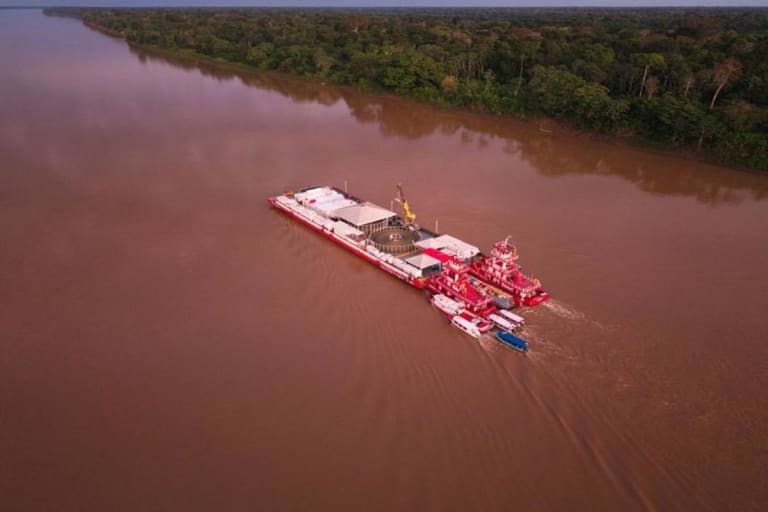
The Norte Conectado project revolutionizes cable installation in the Amazon with unprecedented technology to protect infrastructure and the environment.
The President of the Broadband Implementation Entity (EAF), Gina Marques, announced a significant milestone for the Norte Conectado project during an event in Brasília focused on 5G commitments. The major news is the adoption of a new method for installing subfluvial optical cables in the Amazon, which involves directly burying these cables in the Madeira Riverbed. This technological innovation promises greater durability and reduced environmental impact, reinforcing the commitment to sustainability and connectivity in the Amazon region.
This advancement represents a paradigm shift in the deployment of telecommunications infrastructure in complex environments like the Amazon. The new technical solution aims to overcome the challenges posed by the Madeira River, known for its rocky bed, water level fluctuations, and dredging and mining activities. By introducing cutting-edge technology for cable burial, EAF demonstrates a commitment to infrastructure robustness and environmental preservation.
New Technology for a Challenging River
The innovative methodology will be applied to a critical stretch of the Madeira River, facing conditions such as a rocky bed, dredging, and significant variations between the flood and dry seasons. To enable this operation, EAF imported a specialized cable-burying machine from the United Kingdom. This five-ton piece of equipment is already en route to Brazil, with arrival expected in Manaus between September 15th and 20th.
Upon its arrival, the machine will undergo a rigorous testing and adaptation process in Amazonas, lasting 60 days. Evaluations will be conducted in Manaus and Iranduba, in collaboration with EAF’s partner company. The equipment will be mounted on a dedicated barge to ensure its safe and efficient transport.
Minimizing Impacts and Maximizing Durability
The differential of this new technology lies in its ability to minimize interference with the riverbed and environmental impacts. Using water jets, the machine creates a trench of controlled dimensions, allowing for the safe installation of the optical cable. Subsequently, the river’s own current aids in depositing sediment over the cable, restoring the riverbed and ensuring its protection. This approach reduces the need for invasive interventions, promoting infrastructure installation with minimal environmental impact.
The definitive launch in the Madeira River is scheduled for December, contingent on weather conditions and water levels. The choice of this period for the resumption of Infovia 05 operations adheres to a natural restriction of the region, due to seasonal conditions that prevent the safe and effective execution of the cable launch.
“It cannot be done now due to the river’s hydrological seasonality, so we have no way to proceed with the cable launch,” explained Gina Marques, emphasizing the importance of respecting natural cycles.
Damage Prevention and Savings with Robust Infrastructure
The decision to bury the cables addresses a need identified in earlier stages of the Norte Conectado Program, particularly after the analysis of the Madeira River. The new directive establishes burial in sections with depths of up to 3 meters, where cable exposure to friction is higher. This measure aims to mitigate damage and reduce the incidence of infrastructure breaks.
“We will bury the cable in the river, which will allow us to have fewer breaks—which is very important, because when this cable breaks, the cost of repair is very high,” highlighted the president of EAF, emphasizing the savings and failure prevention provided by the new methodology. The plan includes burying cables in the stretch between Manicoré and Humaitá, extending to Calama.
Infovia 05: Connecting the Amazon
The first phase of Infovia 05 cable deployment was completed in early August, consolidating the advancement of the 1,116 km subfluvial digital corridor in the Madeira River. The installation of fiber optics in the riverbed, a Nature-Based Solution (NBS), avoids deforestation and establishes infrastructure that will benefit over 700,000 people between Amazonas and Rondônia.
The next phase of the operation is scheduled to begin in December, subject to the region’s hydrological conditions, with completion expected in the first half of 2027. The resumption of work will ensure the interconnection of the nine municipalities served by the project, providing access to high-speed connectivity for schools, hospitals, and public agencies, under a neutral operator model.
The Norte Conectado program is one of Brazil’s most ambitious infrastructure and digital inclusion initiatives. Coordinated by the Ministry of Communications and Anatel, and executed by EAF with resources from the Novo PAC, the project plans for the implementation of nine infovias totaling over 13,000 kilometers of subfluvial routes. The objective is to bring high-speed internet and social development to approximately 7.5 million inhabitants in the states of Acre, Amapá, Amazonas, Pará, Rondônia, and Roraima.