
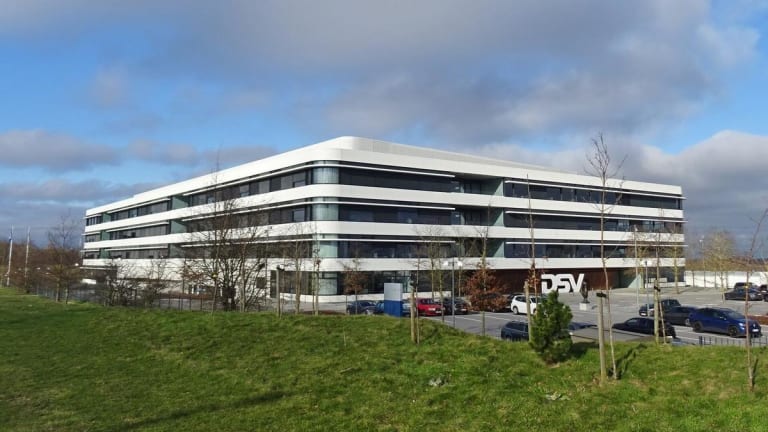
The logistics giant DSV and Google Cloud have announced a strategic partnership focused on reducing the carbon footprint of air transport by using sustainable aviation fuel.
The Danish multinational DSV, a leader in the logistics sector, has entered into an innovative agreement with Google Cloud to implement a pilot project centered on the use of SAF (Sustainable Aviation Fuel).
The announcement, made on November 11, 2026, marks an important step in the technology giant’s decarbonization strategy, forecasting the supply of up to 9.7 million liters of renewable fuel for critical air freight routes.
The initiative aims to mitigate the environmental impact of Google Cloud’s logistics operations, projecting a reduction of 25,000 tons of CO2e (carbon dioxide equivalent) over the fuel’s life cycle.
The project positions both companies at the forefront of the energy transition in the freight transport sector, where decarbonization remains a constant technical and operational challenge.
Investment in waste and transparency
The fuel used in DSV’s pilot is produced entirely from waste and renewable raw materials, strictly excluding palm oil.
According to the company, this feedstock can reduce greenhouse gas emissions by up to 85% compared to conventional jet fuel.
Additionally, the entire supply chain holds ISCC (International Sustainability and Carbon Certification) certification, ensuring rigorous audit and sustainability standards.
To operationalize the environmental benefit, the partnership uses a “book-and-claim” model. This system allows the carbon reduction to be credited to Google Cloud, even if the SAF is physically used in other aircraft.
To avoid double counting and ensure data integrity, the project uses the SAFc Registry, an independent register that tracks environmental attributes transparently.
Commitment to the future of logistics
Frank Sobotka, executive president of DSV’s Air & Sea division, stated:
“Our customers want practical ways to reduce the emissions of the goods they transport. The partnership turns Google Cloud’s sustainability goal into a measurable outcome in air freight”
The move reflects a growing trend among technology companies to seek auditable solutions for the so‑called Scope 3—indirect emissions that occur along the value chain.
For Google Cloud, this is the second major step in the sector in 2026; in June, the company had already signed a similar agreement with Kuehne+Nagel.
This new pilot project is seen by DSV—who recently completed the historic acquisition of Schenker—as a foundation for future large‑scale collaborations.
The expectation is that the success of this initiative will spur new investments in the renewable fuels market, making air freight an increasingly viable option from an ESG perspective.
The companies’ trajectory indicates that similar agreements will become the rule, not the exception, as demand for sustainable logistics operations becomes a global commercial imperative.