
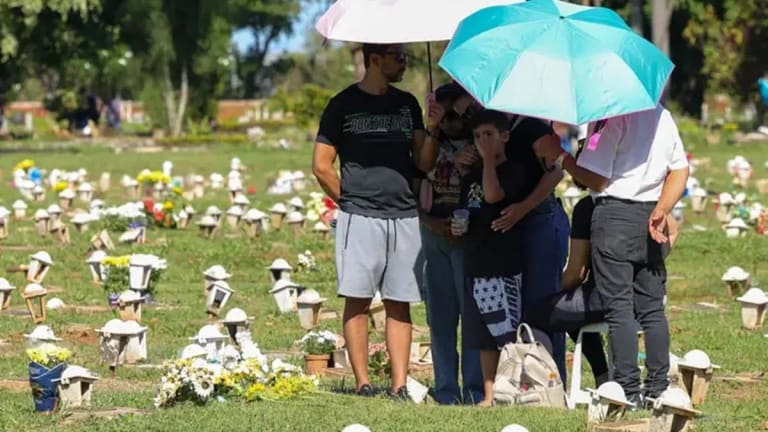
Federal District sees intense activity in cemeteries on All Souls’ Day, bringing families together for traditional rituals of remembrance, affection, and tribute to loved ones.
The early hours of this holiday were marked by strong emotion in the cemeteries of the Federal District. Thousands of people visited the sites to perform the traditional ritual of visiting the graves of deceased family members and friends, keeping alive a century-old tradition of honoring memory and longing.
Between religious rites and care for the graves, All Souls’ Day becomes a moment of deep reflection on life’s finitude and the perpetuation of affection. The date, brought to the country by Portuguese colonizers and rooted in the Abbey of Cluny in France, transcends Catholicism, also mobilizing Protestant believers and followers of African-root religions in praise of ancestors.
Stories of longing and devotion
From Western City in Goiás, Gorete Nascimento, 71, faced the journey to Cemetery Campo da Esperança early, as she has for more than thirty years. With buckets, water, and flowers, she dedicated herself to cleaning the marble where her parents and three sisters rest, maintaining an intimate dialogue with the past and even using the future tense when speaking about commemorative dates of those who have passed.
I come here every All Souls’ Day and also on each one’s birthday because I miss them so much. And to honor my sister, who also never failed to come here on this date.
While older sections display diverse and imposing tomb constructions, the newer wings follow strict standardizations, allowing only discreet plaques, photographs, and candle holders. It was in this more sober setting that Neusa Maria Nora found space for her prayers before observing the day’s movement.
Reflection and Future Perspectives
The strong public turnout at the cemetery on the day underscores the social need for mourning and collective remembrance. Beyond the religious aspect that dates back to the 10th century by decree of the Benedictine monk Odilo of Cluny, the movement in public spaces highlights the essential role that visitation plays in providing emotional comfort to families who have recently lost relatives, especially during critical periods of recent history.
Local administrators expect visitor traffic to remain intense until the end of the day. In the coming years, the management of burial spaces in the Federal District plans new infrastructure improvements to better accommodate the public during the most emotionally charged dates.