
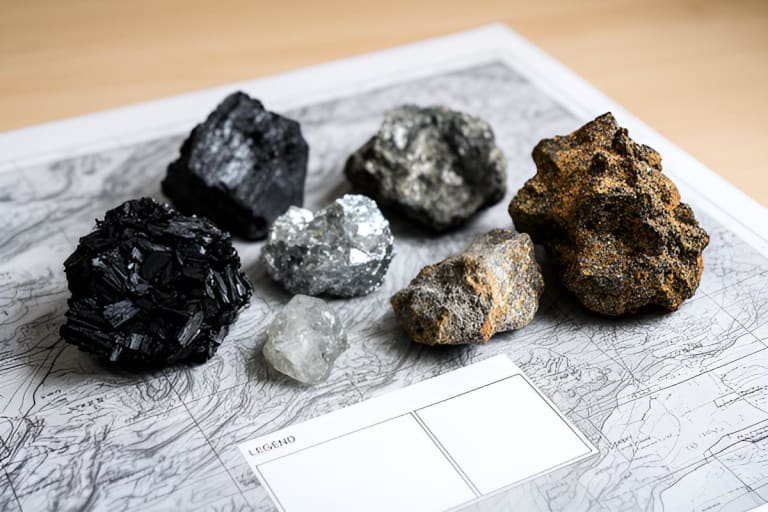
The proposals of candidates Lula and Flávio Bolsonaro for the management of critical minerals reveal divergent views on energy transition, technological sovereignty, environmental licensing, and the socio-environmental protection of communities impacted by mining in Brazil.
In the context of presidential elections, the management of critical minerals emerges as a central theme for Brazil’s economic and sustainable future. These strategic resources—fundamental for the global energy transition and the manufacturing of clean technologies—are abundant in the national territory, placing the country in a prominent position in geopolitical and environmental discussions.
How the next government will handle the exploration and processing of these assets will define Brazil’s insertion into the global market. As demand for clean energy components grows, presidential candidates present contrasting strategies ranging from the pursuit of technological sovereignty to incentivizing international private capital with a focus on regulatory flexibility.
Lula’s Proposals: Sovereignty and Value Addition
In candidate Lula‘s Government Plan, the priority is to ensure technological sovereignty and prevent the country from acting solely as an exporter of raw materials. The proposal seeks to integrate critical minerals and rare earths into a national neo-industrialization and re-industrialization strategy, stimulating local value addition and the creation of skilled jobs.
Lula stated:
“In the next governmental cycle, our central objective will be to improve and strengthen neo-industrialization, rethinking the role of industry in Brazil based on society’s priorities… The strategic focus is on innovation, AI, critical minerals, and other assets capable of making Brazil a protagonist in future-oriented areas once and for all.”
The plan also foresees a specific policy to organize global value chains and map reserves with a focus on sovereign regional development. Read Lula’s proposal in full.
Flávio Bolsonaro’s Proposals: Attracting Capital and Agile Licensing
On the other hand, Flávio Bolsonaro‘s Government Plan prioritizes attracting foreign capital and international technologies, combined with streamlining environmental licensing. The proposed vision positions the State as a regulator and coordinator of the market, aiming to meet the demand of new technological sectors and data centers.
Flávio Bolsonaro declared:
“Instead of just exporting raw ore and buying back the finished product, we will add value in Brazil, connecting our mineral wealth, our energy, and the demand from data centers and new technologies into a unique strategy. The State will act as a regulator and coordinator, not as an entrepreneur…”
To accelerate mining processes, the candidate proposes international partnerships without ideological hurdles and more stable regulatory frameworks. Read Flávio’s proposal in full.
Expert Analysis and Socio-Environmental Impacts
Industry experts warn about the implications of each model. Researcher Elisangela Soldateli Paim highlights that the proposals reflect opposing development projects. She points out that accelerating environmental licensing could weaken socio-environmental guarantees if there is no active participation from affected communities in the guidelines of the National Policy on Critical and Strategic Minerals (Law No. 15.506/2026).
Elisangela Soldateli Paim emphasized:
“The absence of formal representation from civil society and potentially affected communities on the council responsible for guiding this policy raises concerns about decision-making being concentrated around state and private interests, without effective democratic participation…”
Author of the collection Empire of Extraction: Capital, Crisis, and Struggles for Climate Justice, the expert warns about the need to ensure democratic governance to mitigate territorial conflicts.
Meanwhile, former federal deputy Áurea Carolina emphasizes that excessive acceleration of licensing increases environmental risks. According to her, the country should use re-industrialization programs to generate skilled jobs internally, ensuring sovereignty against the interests of foreign powers.
Áurea Carolina stated:
“Flávio Bolsonaro’s plan treats critical minerals as a business. Accelerating licensing may please the market, but it increases the environmental risk of mining… The path must be different: industry here, technology here, quality job creation here, and above all, sovereignty…”
Safety of Communities Around Mining Areas
A critical point highlighted by social organizations is the absence of concrete plans for the safety of populations affected by extractive activities in both proposals. Helena Taliberti, president of the ICLT, warns that the debate cannot be limited to economic gains and geopolitical disputes.
Helena Taliberti declared:
“It is concerning that the discussion about rare and strategic minerals focuses on economic potential, attracting investments, and geopolitical competition, while the safety and quality of life of communities living with mining do not receive the same attention. Both Lula and Flávio Bolsonaro need to answer a fundamental question: what is the plan to protect the people living in the territories where these minerals will be extracted?”
Conclusion
The management of critical minerals consolidates itself as an indispensable pillar for Brazil’s economic and environmental matrix. While combating illegal mining and prospecting is on the radar, the real challenge for the next presidential cycle will be balancing investment attraction with social and environmental protection.
The choice of governmental model will shape not only Brazil’s capacity to lead the global energy transition but also its ability to reconcile industrial progress, climate justice, and the preservation of local populations’ rights.