
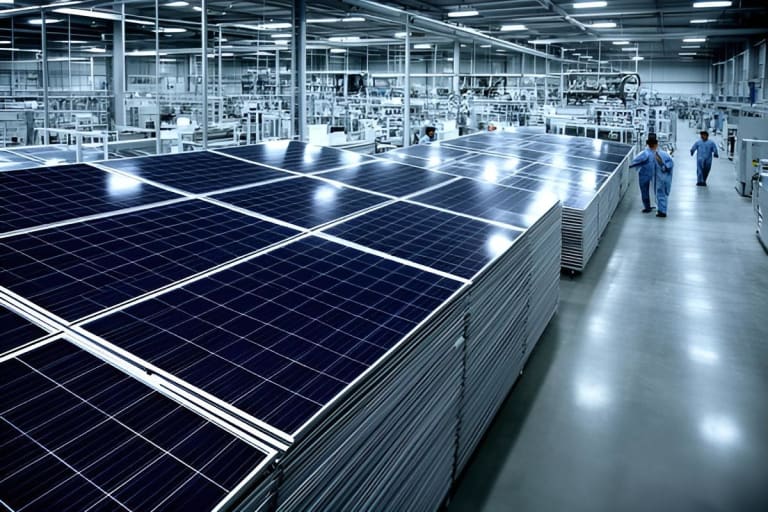
More than 90% of Chinese solar equipment manufacturers end 2026 in the red, despite high demand.
The global solar energy industry faces a paradox: while demand for clean sources continues to rise, the vast majority of leading photovoltaic equipment manufacturers in China recorded losses in 2026. According to a recent report from the International Energy Agency (IEA), over 90% of these companies accumulated financial losses, highlighting a crisis that contrasts with the optimism surrounding the energy transition.
The scenario is marked by excess production capacity and a sharp decline in equipment prices. These factors have eroded company profit margins, leading to a concerning number of bankruptcy filings. Since 2024, more than 70 Chinese sector firms have sought judicial recovery, a direct reflection of competitive pressure and the difficulty of monetizing large-scale production.
China’s Domain Under Pressure
China holds an undisputed leadership position in the global photovoltaic supply chain, from polysilicon extraction to final solar module assembly. However, the unchecked expansion of industrial capacity, outpacing demand, has intensified internal competition. This fierce rivalry has driven continuous price reductions, compromising operational profitability and plunging much of the sector into financial distress.
The shift in China’s subsidy model—from fixed tariffs to competitive auctions—also contributed to a market cooling. In the first nine months of 2026, the country’s photovoltaic capacity expansion contracted by almost 55% compared with the same period last year. This slowdown prompted the IEA to revise downward its growth projections for Chinese renewable capacity between 2026 and 2031, cutting about 116 GW.
Nonetheless, the agency stresses that the Asian country will remain a key player in the global expansion of renewable energies, potentially surpassing its own installed capacity targets.
Seeking Diversification and the Future of Solar
The concentration of photovoltaic production in China has spurred the search for alternatives and diversification of the supply chain. In this context, India emerges as a promising market, with the potential to become the only country, besides China, capable of manufacturing all essential components of the photovoltaic chain at scale by 2031. This expansion in India could mitigate geographic dependence and offer more options to international markets.
Despite the challenges faced by Chinese manufacturers, the outlook for solar energy worldwide remains robust. The IEA estimates a nearly 85% growth in installed renewable capacity between 2025 and 2031, with solar accounting for the majority of that advance. The total volume of global renewable capacity expansion is expected to be 57% higher than the previous six years.
However, a relative decline in China’s share of this global growth is observed. Other markets, such as India, Southeast Asia, Africa, and the Middle East, are gaining relevance, driven by incentive policies and the pursuit of energy security. Projections for the United States, India, Sub-Saharan Africa, and Latin America have also been revised upward by the agency.
The continued rise in global demand for solar energy, according to the IEA, will continue to sustain the expansion of installed capacity, even in a financially challenging environment for part of the production industry.