
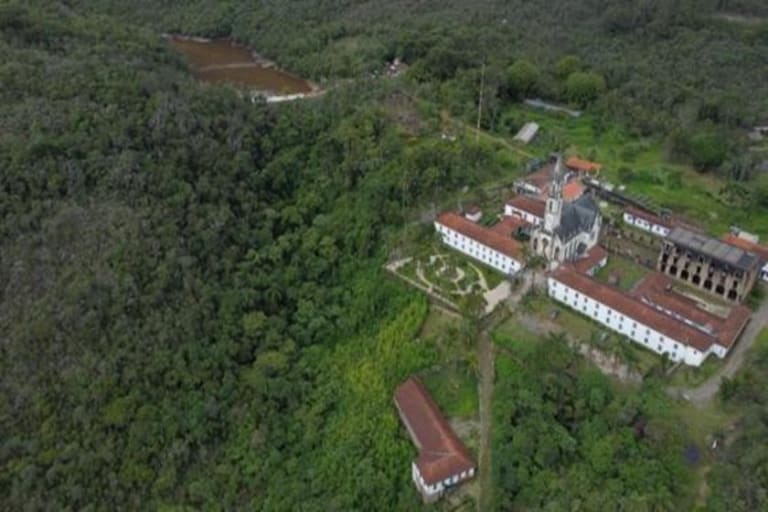
The Tanque Grande at Caraça Sanctuary hides the structure of Minas Gerais’s second hydroelectric plant. Over 130 years old, the site combines technological pioneering, preserved history, and lush nature for visitors.
Amidst the imposing mountains of Serra do Espinhaço, about 75 miles from Belo Horizonte, the Caraça Sanctuary holds a fundamental chapter in the history of Brazilian infrastructure.
Beneath the serene waters of Tanque Grande lies the 1893 dam, the landmark that gave rise to the second hydroelectric plant in Minas Gerais.
More than just a 19th-century engineering feat, the lake today forms one of the reserve’s most stunning landscapes, serving as a mandatory stop for those seeking connection with nature and the region’s historical past.
Pioneering amidst the mountains
The site’s history dates back to 1774, with the founding of the hermitage by Brother Lourenço de Nossa Senhora, who later established the prestigious Colégio do Caraça.
It was within this educational environment, under the tutelage of the Lazarist priests, that the cutting-edge technology of the time was implemented. On November 20, 1893, the complex generated its own electric light, overcoming the darkness that dominated much of Brazil during that period.
The plant, which operated until 1959, used the water to power a sawmill during the day and supply the college’s dynamo at night.
The venture, which endures as a legacy of innovation, positioned the site as a pioneer in the generation of clean and renewable energy in the state, second only to the Marmelos Plant.
Father Adalberto Costa, administrative director of the Caraça Sanctuary, stated:
Tanque Grande is one of Caraça’s greatest treasures. Few imagine that this serene lake was, over 130 years ago, the heart of a pioneering project that brought electric light to the College. Today, it invites visitors to contemplate history and nature in a unique landscape.
Nature and contemplation
While Tanque Grande is a historical gem, the Caraça Sanctuary offers a vast itinerary of water attractions for visitors seeking to cool off.
Although the old hydroelectric plant’s lake is preserved for contemplation, well-marked trails lead to destinations like Cascatinha, Banho do Belchior, Tabuões, and the imposing Cascatona, which enchant tourists with natural pools and crystal-clear water wells.
The memory of this technological transition period also survives in the region’s oral traditions. As the late Father Lauro Palú recalled:
I remember seeing the brother lighting the path with a lantern at night to turn off the plant.
A refuge for the future
Today, the complex is an example of sustainability and environmental preservation, integrating protected areas such as the Private Natural Heritage Reserve (RPPN). By visiting the site, travelers not only discover the history of the second hydroelectric plant in Minas Gerais but also contribute to the maintenance of an ecosystem rich in biodiversity.
Whether by car, via the Estrada do Caraça, or through the classic experience of the Vale Passenger Train, the journey to the sanctuary is an invitation to slow down. The impact of this visit goes beyond tourism: it is a rediscovery of the history of energy in Brazil and an appreciation of natural heritage that, when protected, continues to be a source of life and knowledge for future generations.
For more information on accommodation and hours, visit the official website at www.santuariodocaraca.com.br.