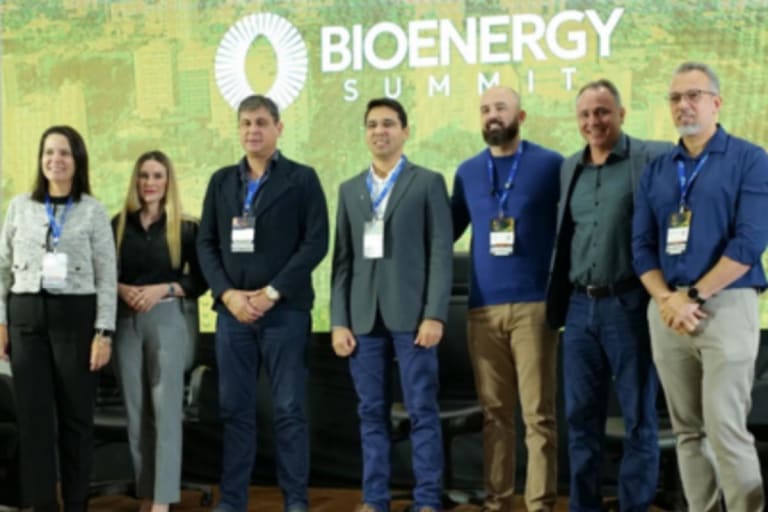
Mato Grosso do Sul solidifies its position as a bioenergy hub, focusing on sustainability and new business opportunities, driving the national energy transition.
The city of Campo Grande, located in Mato Grosso do Sul, recently hosted the Bio Energy Summit 2026, a highly significant event for the clean energy sector. Held on September 15 and 16, the gathering served as a platform to discuss the potential of bioenergy in Mato Grosso do Sul, attracting specialists, investors, and industry representatives to deliberate on innovative technologies, market expansion, and new investment opportunities, thus strengthening the state’s leading role in the energy transition agenda.
The event, which received institutional support from the Mato Grosso do Sul Bioenergy Producers Association (Biosul), took place at a crucial time for the state. Driven by a robust agribusiness sector, vast biomass availability, and an established bioenergy industry, Mato Grosso do Sul has expanded its participation in national discussions on renewable energy sources. The synergy between agricultural production and clean energy generation positions the state as a leader in the pursuit of more sustainable energy solutions.
Waste Utilization and Biomethane in Focus
One of the pillars of the Bio Energy Summit 2026 was the utilization of agro-industrial waste as a source for producing biogas and, subsequently, biomethane. This approach transforms byproducts from swine farming, poultry farming, and the sugarcane energy sector into valuable energy resources. Biomethane, in particular, emerges as a promising alternative to fossil fuels, with the potential to power heavy vehicles, agricultural machinery, and industrial processes, significantly contributing to the economy’s decarbonization.
The technical director of Biosul, Érico Paredes, emphasized the importance of capitalizing on existing infrastructure to generate new business opportunities. “The challenge now is to transform the existing structure into new business opportunities,” Paredes stated. This vision underscores the growth and innovation potential that bioenergy offers for sustainable economic development, aligning production with environmental preservation.
Connecting Technology and Market
Tiago Fraga, director of Grupo FRG Mídias & Eventos, the Summit organizer, emphasized how Biosul’s participation was fundamental in bridging the technical debate with the practical reality of companies. This collaboration facilitated knowledge exchange and the identification of viable solutions for sector challenges. The event’s program covered everything from the advancement of sugarcane and corn-derived biofuels to the latest technological innovations and investment models focused on carbon emission reduction.
The renewable energy agenda in Campo Grande was not limited to the Bio Energy Summit. Starting on September 17, the city hosted the 32nd Midwest Regional Distributed Generation Forum. Also promoted by Grupo FRG, the forum, which ran until the 18th, focused on solar generation, energy storage technologies, available financing options, regulatory discussions, and challenges for the expansion of distributed generation. Over four days, the capital of Mato Grosso do Sul became the stage for essential discussions, covering everything from large-scale biofuel production to decentralized energy generation closer to the end-consumer, reinforcing the state’s commitment to a cleaner and more diversified energy future.